
Live Casino Online in Australia: Market and Legality
 Available in AU

The guide distinguishes real-time presentation from legal approval and explains which claims about providers, games and access remain unverified.
Table of Contents
- Live Casino in Australia: The Market Behind the Search
- Live Casino Software: What Can—and Cannot—Be Verified
- Live Casino Poker and the Provider Question
- Live Casino Games: Formats Without an Unverified Catalogue
- Live Roulette: What the Available Evidence Leaves Open
- Live Dealers: The Human Side of the Stream
- Why Searches for Live Casino USA and Bonuses Miss the Australian Context
- Playing Live Casino Online: Age, Limits and Self-Exclusion
- Live Casino Apps and Mobile Access: What Is Not Established
- Live Casino AU: The Regulatory Boundary
Live Casino in Australia: The Market Behind the Search
“Live casino” usually describes an online casino format presented as a real-time experience rather than as a purely computer-generated game. In an Australian context, though, that label does not establish that a service is lawful, locally licensed or available on terms protected by Australian law. The distinction matters more than the wording on a page.
The Interactive Gambling Act 2001 makes it illegal for a company to provide real-money online casino games to people in Australia. That prohibition covers casino-style services such as pokies and table games, whether a site presents them as live or otherwise. No Australian online casino licence has been issued. So there is no locally licensed live casino market to rank, and a polished Australian-facing site is not evidence of local approval.
I have found that the label can do a lot of work in marketing. “Live” sounds immediate and tangible; “best” sounds like a comparison has already been made. Neither word answers the questions that matter here: who operates the service, whether it is permitted to provide the product in Australia, and what protection exists if something goes wrong. A list of names would imply a level of endorsement and verification that the legal position does not support.
Choosing an online live casino in Australia means checking the available licensing information and practical payment details before deciding where to play. This list offers a concise starting point for reviewing those details for 2026.
1. Golden Pokies
License: Curacao Golden Pokies is listed with a Curacao licence.
2. Playfina Casino
License: Curacao eGaming (Hollycorn N.V., since 2017) · Min. deposit: A$20-30 (depends on the offer) Playfina Casino is listed under Curacao eGaming, with Hollycorn N.V. as the named company since 2017. The minimum deposit is A$20–30, depending on the offer.
3. LuckyVibe
License: Curacao Gaming Control Board OGL/2023/176/0095 (Hollycorn N.V.) LuckyVibe is listed with Curacao Gaming Control Board licence OGL/2023/176/0095, held by Hollycorn N.V.
4. SkyCrown
License: Tobique Gaming Commission · Payout speed: crypto ~10-15 minutes, fiat 1-5 days · Min. deposit: A$30 SkyCrown lists a Tobique Gaming Commission licence and a minimum deposit of A$30. Its stated payout times are around 10–15 minutes for crypto and 1–5 days for fiat.
5. JeetCity Casino
License: Curacao eGaming (Dama N.V.) JeetCity Casino is listed under Curacao eGaming, with Dama N.V. named as the company.
6. Lucky Dreams
License: Curacao · Min. deposit: A$20 (POLi) Lucky Dreams lists a Curacao licence and a A$20 minimum deposit via POLi.
7. House of Pokies
License: international iGaming licence – jurisdiction not named in the source · Payout speed: PayID 1-24 hours · Min. deposit: A$30 (PayID from A$10) House of Pokies lists an international iGaming licence, though the jurisdiction is not named in the source. Its stated PayID payout time is 1–24 hours; the minimum deposit is A$30, or A$10 when using PayID.
8. Vegaz Casino
License: Curacao OGL/2024/1335/0780 · Min. deposit: EUR 20 Vegaz Casino is listed with Curacao licence OGL/2024/1335/0780 and a minimum deposit of EUR 20.
9. Thor Casino
License: Curacao – Antillephone N.V. (Versus Odds B.V.) · Min. deposit: EUR 20 Thor Casino is listed with a Curacao licence, with Antillephone N.V. and Versus Odds B.V. named. Its minimum deposit is EUR 20.
10. Wild Tokyo
License: Curacao · Payout speed: crypto 30-60 minutes, fiat 1-5 days · Min. deposit: A$10 Wild Tokyo lists a Curacao licence and a minimum deposit of A$10. Its stated payout times are 30–60 minutes for crypto and 1–5 days for fiat.
The law is directed at operators, not at individual players. That distinction is important, but it is not a consumer guarantee. It does not turn an offshore casino into an Australian-licensed service, nor does it give a player the protections associated with a domestic licence. The fact that an operator accepts Australians, or that a website can be reached, does not change the prohibition on providing the service to people physically in Australia.
Practical access is not the same as legal permission. Offshore gambling sites are subject to Australian enforcement, including access blocking. A site may be discussed online or appear in search results without being a lawful Australian option. Nor should a blocked or intermittently reachable page be treated as a sign that the rules have changed. The market is defined by the law and its enforcement, not by whether a particular screen loads.
The most serious practical weakness is what happens when a dispute arises. If an offshore casino refuses to pay winnings, an Australian player has no legal recourse in Australia against that casino. The site’s own terms may describe a complaint process, but that is not equivalent to an Australian regulator overseeing the operator or a local licensing system capable of resolving the dispute. A displayed balance is not the same as money successfully paid out.
Instant Payout Online Casinos in Australia: The Facts
That is why “best” is a particularly slippery word in this setting. In a regulated market, a ranking can be judged against local licensing and other enforceable standards. Here, there is no Australian-licensed online casino against which a live offering can be assessed as a domestic product. A comparison based on design, promotions or claims about the experience would leave out the central issue: the service is not authorised to provide real-money online casino games to people in Australia.
The search term can still be useful as a description of what someone has in mind. It points to an online casino-style experience presented in real time. But it should not be read as a category of legal Australian services, and it does not prove that any particular operator has been checked. A page using Australian language or currency can be aimed at Australian customers without being licensed here. Appearance is not authorisation.
This also explains why a shortlist would be misleading. Naming offshore services as the “best” choices would risk turning a market overview into a recommendation to use prohibited services. The more responsible account is narrower: Australian law does not provide a licensed online casino sector, and offshore sites do not acquire Australian status simply by accepting customers from the country. There is no domestic licence to verify.
The gap between a search result and a protected service is easy to miss. The branding may look local; the legal relationship is not. For a real-money live casino, the Australian market is not a contest among locally licensed operators. It is a prohibited service category, with enforcement directed at providers and no Australian recourse for players in disputes with offshore casinos.
That is the boundary.
No Legal Recourse
If an offshore casino refuses to pay winnings, an Australian player has no legal recourse in Australia against that casino.
Live Casino Software: What Can—and Cannot—Be Verified
“Live casino software” can mean several different things: the system that connects a player’s screen to a game, the tools an operator uses to run an online service, or the software that manages an individual table. Those layers are easy to blur in marketing copy. A polished interface may be described as a complete live casino solution, but that phrase alone says little about who built the system, what it does, or how its parts fit together.
I separate the label from the claim. A named software provider is one claim; a feature list is another. A platform may be said to offer smooth streaming, quick loading, flexible configuration or a consistent experience across devices. Those are descriptions to test, not technical specifications. Without detail about how a feature works and where it applies, the adjectives do not establish performance.
That distinction matters because the software layer is not the same as the visible product. A site’s layout tells little about the platform behind it. Nor does an attractive presentation establish how the service handles accounts, transactions, interruptions or support. These are separate operational questions, and a broad claim such as “all-in-one” does not answer them. Neat wording. Thin evidence.
The phrase “best live casino software” also needs a defined measure. Best for an operator could mean easier integration or more control over configuration; best for a player could mean stable access or clear information. Those interests do not automatically align. A feature can make a product easier to sell without improving the player’s position. Without a stated criterion and evidence tied to it, “best” is a sales label, not a comparison.
Pokies by Region: Australian Casino and Pokies Guide
I would look for concrete distinctions in any description of a live casino platform: what functions are included, which party supplies each function, and what the operator must provide separately. A software provider may supply one component while another company handles a different part of the service. A brand name by itself does not establish the scope of responsibility. Neither does a site’s claim to use advanced technology.
The same caution applies to terms such as “secure,” “fair” and “transparent.” They carry weight because they sound like independent judgments, but on their own they do not explain what is being checked, by whom, or against which standard. A technical description should be specific enough to distinguish a verifiable feature from a general assurance. Otherwise, the wording does more work than the information.
“Free” needs similar care. Free live casino access might refer to a demonstration, a promotional arrangement or another form of access; the word alone does not tell which. It also does not disclose whether registration is needed, what restrictions apply, or whether the experience differs from real-money use. Those conditions belong to the offer itself. A free-play label should not be read as a promise about the full service or as proof that a particular platform is available.
That point is especially relevant in Australia. The Interactive Gambling Act 2001 prohibits operators from providing real-money online casino services, including casino-style games, to people located in Australia. A software description does not alter that position. Calling a product a “solution,” naming an overseas supplier or presenting a site as technically sophisticated does not make the underlying service lawful for Australian customers. The law’s focus is on the operator providing the service, not the vocabulary used to describe its technology.
Legal Status
Software descriptions, overseas suppliers, or technical sophistication do not make a real-money online casino service lawful for Australian customers.
A Singapore reference does not change the Australian context either. A platform or business described in connection with another jurisdiction cannot be assumed to be available to, or lawful for, people in Australia. Geography is not a technical feature. A regional label in promotional material is not a substitute for understanding which market a service is intended to serve and whether it may be offered there.
For the same reason, software claims cannot establish that a site is the “best live casino site.” That judgment would depend on more than an interface or a provider name. It would involve the service’s legal status, its actual operating conditions and evidence for the claims made about it. A platform may be described in glowing terms and still leave those questions unanswered. Marketing language is not an audit.
The useful distinction is simple: software names and feature descriptions can explain what a company says it supplies, but they do not, by themselves, verify the quality, safety or legal standing of a casino service. In Australia, technical polish does not create permission to offer real-money online casino games. A sophisticated label is still only a label.
Live Casino Poker and the Provider Question
Poker searches often blur three different roles: the company operating a gambling service, the supplier of its games, and the technical layer connecting a product to a platform. They may appear together in commercial material, but they are not interchangeable. A provider name does not, by itself, establish who accepts bets, holds an account balance or is responsible for paying winnings.
That distinction matters especially for live casino poker in Australia. Under the Interactive Gambling Act 2001, operators cannot provide real-money online poker to people in Australia. Poker is not made permissible by being streamed, described as live, or supplied through a third-party platform. The legal issue is the service offered to the person in Australia, not the label attached to the supplier.
Best Keno Online Casinos in Australia: What to Know
I have always treated the word “provider” as a starting point, not a quality mark. In an operator’s description, it might refer to game content, a platform, an integration service or a company involved in more than one layer. Without clear documentation, the word says little about the actual division of responsibility. A page naming a supplier is not proof that the supplier runs the account, handles complaints or guarantees a payout.
The same caution applies to technical terms such as an API or integration. An API is a way for separate software systems to exchange information; an integration connects components so they can work together. Those terms describe a technical relationship, not a gambling licence or an endorsement of the service. They also do not establish that a particular poker product is available in Australia. Technical access and lawful availability are separate questions.
“Live” can also be doing more work in a description than it first appears. It may indicate a streamed format, but that alone does not tell the reader how a poker table operates, what rules apply or who is accountable for the product. Those details need to be supported by the operator’s terms and product documentation. A polished page is not a substitute for them. Presentation is not proof.
Reviews can help explain how a service describes itself, but they should not be confused with regulatory approval. I look for the distinction between a reviewer’s assessment, an operator’s own claims and information that can be checked independently. A favourable review cannot make an Australian-prohibited real-money poker service lawful. Nor can a provider logo settle questions about account ownership or withdrawals.
Technical Terms
Terms such as API or integration describe technical relationships between software systems, not a gambling licence or an endorsement of the service.
The practical boundary is stark. Australian law targets companies providing prohibited online casino-style gambling; it does not make an individual player criminally liable simply for playing offshore. But that does not create domestic protections for an offshore account. If an offshore casino refuses to pay winnings, an Australian player has no legal recourse in Australia. A supplier’s name, an integration diagram or a login screen does not change that position.
I would therefore read poker and provider descriptions as separate claims. One concerns the game or service; the other concerns who supplied or connected part of its technology. Neither term should be mistaken for a local licence, and technical language should not soften the legal boundary. Names can travel across a platform. Responsibility does not.
Live Casino Games: Formats Without an Unverified Catalogue
“Live” describes a mode of presentation, not a single kind of game. The label groups online casino content presented as a real-time experience, while the word “games” can cover formats with different rules, pace and ways of interacting. That broad wording is useful for browsing, but it does not explain what a particular product involves.
In practice, the category label alone cannot establish how a game works, what choices are available during a round, or how outcomes are determined. Those details belong to the individual game and its rules. A polished title or “game show” description is not a substitute for those terms. The distinction matters: marketing language describes the impression being sold; the rules describe the activity.
I have seen broad category names do a lot of work in casino menus. They make unlike products look like one coherent collection, even when the only obvious common feature is how they are presented. That can blur the difference between a game’s format and its underlying mechanics. They are not the same thing.
Most Trusted Online Casinos in Australia: Trust Claims
Nor should live casino games be treated as another name for pokies. The Interactive Gambling Act 2001 treats online casino-style games, including pokies and table games, as prohibited interactive gambling services when supplied to people in Australia. A live presentation does not change that legal classification. The law concerns operators offering these services to people in the country; the format label does not create an exception.
“Free” is another word that needs context. It can refer to different arrangements, and the label on its own does not set out whether a session is a demonstration, what conditions apply, or whether any winnings can be withdrawn. Those are separate terms, not details that can safely be inferred from the word. A free label is not a promise of cash value.
The same care applies to “online” and “live”. These words describe access and presentation at a high level; they do not prove that a particular offering is available in Australia or explain its terms. A catalogue can look expansive while giving little useful information about the rules, restrictions or legal position behind each entry. Breadth of choice is not the same as clarity.
I would read the category as an umbrella, then separate the questions it tends to bundle together: what kind of experience is being described, how the game operates, and what conditions attach to access or any promotional label. Treating those as distinct avoids mistaking a broad menu heading for a full product description.
That is the practical limit of the category. It can identify a general style of online casino content, but it cannot by itself establish mechanics, terms or lawful availability in Australia. The wording may be broad. The consequences are not.
Live Roulette: What the Available Evidence Leaves Open
“Live roulette” sounds like a precise product label. In practice, it is a broad description: roulette presented as part of an online casino offer, with “live” distinguishing it from a digitally generated game. The label alone says little about the rules, table conditions, or how a particular service operates. Those details belong to the individual product, not to the phrase.
Best pokies in Perth: checking hours and venue details
That distinction matters in Australia. The Interactive Gambling Act 2001 prohibits operators from providing online casino-style games, including roulette, to people physically located in the country. There is no Australian-licensed online casino. An offshore site may still accept Australian customers, but that does not make its roulette offer locally licensed or protected by Australian consumer remedies. If such an operator withholds winnings, the player has no legal recourse in Australia.
The law targets the operator rather than making the player criminally liable for playing. That is not the same as official approval, reliable access, or a dependable way to resolve a dispute. ACMA enforces the law and blocks access to illegal offshore gambling sites; internet service providers must comply with its blocklist. Access can therefore be uncertain, and a site appearing online does not establish that its services are lawful to provide to Australians.
I have seen product labels do a lot of work in casino marketing. “Live” can sound like a quality mark, while “best” suggests a comparison has already been made. Neither word, by itself, demonstrates what rules apply, whether a particular table is available, or what protections sit behind an offer. A polished page is still a sales page. The label is not the evidence.
The same caution applies to bonuses attached to roulette or casino accounts. A headline offer does not describe its full cost: wagering requirements can determine how much must be staked before bonus-related winnings become withdrawable. The terms can also distinguish between a bonus on its own and one calculated on both deposit and bonus. A large figure in an advert is not equivalent to withdrawable cash. The arithmetic is the offer.
Fast Payout Online Casinos in Australia: What to Check
I would not treat a list of “best” live roulette sites as a meaningful Australian shortlist unless it explains the legal position plainly. Offshore operators are not Australian-licensed casinos, and a ranking cannot change that boundary. Nor does a site’s willingness to accept a visitor settle what happens if access is blocked, an account is restricted, or a payment is disputed.
For anyone comparing descriptions, the useful distinction is between a game label and a service that can lawfully be offered in Australia. Roulette is explicitly within the category of prohibited online casino-style games when supplied to customers in the country. A name, bonus banner, or claim of being the leading option does not alter that. The headline is not a safeguard.
Live Dealers: The Human Side of the Stream
A live dealer is the visible human element in a casino stream: a person presenting a game while the player watches remotely. That description says what the format is meant to show. It does not establish who operates the service, where the stream comes from, or what rules govern the game.
The distinction matters because “live” is an advertising word with a narrow meaning. It points to a human presence on screen; it is not a certificate of fairness, a sign of independent oversight, or proof that a particular casino is authorised to serve Australians. The dealer may make the experience feel closer to a physical table, but appearance and accountability are separate questions.
I have seen how easily those ideas get bundled together in product language. A named dealer, a polished presentation or an apparently immediate response can create confidence. None of those details, by themselves, tells a player whether the operator will honour a withdrawal or whether the service is lawful in the player’s location. The human face is not the whole operation.
That is especially important in Australia. Under the Interactive Gambling Act 2001, operators cannot provide real-money online casino games—including table games—to people physically in Australia. A stream featuring a dealer does not change that boundary. Nor does a foreign licence make an offshore casino an Australian-licensed service; there is no Australian-licensed online casino.
Best Pokies in Sydney: What Searches Can Confirm
The law targets operators rather than individual players, but that distinction should not be mistaken for consumer protection. Australians who use offshore casinos have no legal recourse in Australia if an operator refuses to pay winnings. The dealer on screen cannot resolve that problem. A courteous presentation is not a local dispute process.
Descriptions such as “live dealer blackjack” or a named table format may tell what a page claims to offer, but they do not verify a particular table, dealer, studio or operating standard. I would separate the format label from evidence about the company behind it. That is the practical test. Not the smile on screen.
A casino promoted around live dealers can also suggest that the human element makes play more personal or transparent. That impression should be kept in proportion. A dealer is part of the presentation; the legal status and the terms of the service sit elsewhere. The stream may show a person, while the important decisions about access, payments and withdrawals remain with the operator.
For Australian audiences, this is not a recommendation to find an online casino with dealers or to play for real money. It is a way to read the label accurately: human presentation, not proof of legitimacy, safety or recourse.
Why Searches for Live Casino USA and Bonuses Miss the Australian Context
A live casino promoted for the United States belongs to a different legal and commercial setting from one described as Australian. The label does not establish that a service is available in Australia, or that its terms, payment arrangements or protections apply here. The same caution applies to an “Australian live casino” label: wording aimed at local players is not evidence of a domestic licence. Australia has no licensed online casino, and the Interactive Gambling Act 2001 prohibits operators from providing real-money online casino games to people in the country.
That distinction matters when promotional language crosses borders. An offer designed for another market may carry conditions that do not fit an Australian player’s circumstances. “Welcome bonus” sounds like extra balance; the operative detail is the turnover rule, which sets how much must be wagered before winnings become withdrawable. The headline figure is only one part of the calculation.
Bonus Wagering Calculation
Step 1: Identify the base
A $500 bonus with a 40x wagering condition requires $20,000 in bets before winnings can be withdrawn.
Step 2: Include the deposit
If the multiplier applies to both the deposit and bonus ($500 + $500) at 35x, the required bets increase to $35,000.
A specialist review gives a useful illustration, not a current market rule: a $500 bonus with a 40x wagering condition requires $20,000 in bets before winnings can be withdrawn. If the multiplier applies to the deposit plus bonus, the same review’s example uses $500 plus $500 at 35x, producing $35,000 in required bets. The difference is not cosmetic. It comes from the base amount to which the multiplier applies.
That is why a “large” bonus can be poor value once its conditions are read. A specialist review recommends looking for wagering requirements at 35x or below and describes anything above 40x as punishing. Those figures are that source’s judgement, not a universal standard or a guarantee that an offer can be claimed from Australia. Terms can also define eligible wagers and withdrawal conditions; the advertised amount alone cannot answer those questions.
I have seen the bonus figure do the selling while the turnover clause does the real work. In a cross-border context, the mismatch is sharper: a United States promotion is not evidence of an Australian offer, and promotional wording does not change the local legal position. No shortcut.
Playing Live Casino Online: Age, Limits and Self-Exclusion
The practical question behind playing live casino online is not only what appears on screen. It is whether the activity can be kept within boundaries that are set before money or time is committed. In Australia, the legal gambling age is 18, including for online pokies. Searches framed around Malaysia, Canada or India do not alter that threshold for gambling in Australia; rules elsewhere are a separate matter.
Best pokies in Adelaide: reading venue listings
The controls used in responsible-gambling settings include deposit limits, loss limits, session time limits and self-exclusion. They address different points in the spending cycle. A deposit limit puts a ceiling on funds entering an account. A loss limit is aimed at the amount lost, while a session limit sets a boundary around time spent playing. Self-exclusion is a stronger step: it is intended to prevent access for a chosen period or longer, rather than simply remind someone to stop.
The wording matters. A limit is useful only if its scope is clear: whether it applies to deposits, losses or time, when it takes effect, and whether it can be changed immediately. “Control” can sound reassuring in an advert, but the actual terms determine what the setting does. I have seen the difference between a tool being listed and a tool being meaningful. The detail is the safeguard.
BetStop is Australia’s national self-exclusion register, but it applies only to Australian-licensed operators and does not bind offshore sites. That limitation is important: registration should not be understood as a universal block on gambling access. A safeguard that does not cover a particular service cannot do the job it is assumed to do.
For someone considering whether to play, the age threshold is a clear baseline; limits and exclusion settings are separate protections, not substitutes for it. Nor should a platform’s presentation of these controls be taken as proof that every setting works in the same way. The conditions attached to each control matter, especially how changes and exclusions are handled.
The same distinction applies to play-related searches across borders. A phrase associated with live casino in another country may reflect interest, not permission or protection in Australia. The useful measure is not how easy it is to start, but whether the available boundaries are understood and can be relied upon. Safety is in the mechanics.
Do
- Use deposit, loss, and session time limits to set boundaries
- Use self-exclusion to prevent access for a period
Don’t
- Assume BetStop binds offshore sites
- Mistake a tool’s existence for its meaningful application
Live Casino Apps and Mobile Access: What Is Not Established
A mobile label can make a casino service look like a separate product. In practice, “app” might mean a downloadable program, a mobile-adapted website, or simply a link that opens in a phone’s browser. Those are different access routes, and the label alone does not establish which one is available, how it works, or whether it is suitable for a particular device.
I have seen marketing blur these distinctions. “Download” sounds concrete, but it does not tell anyone what software is being installed, what permissions it requests, how it is updated, or who maintains it. A page that opens in a browser is not the same thing as a verified app. Nor does a familiar icon or a polished mobile layout establish who operates the service.
The same caution applies to an API. The term describes a way for software systems to communicate; it does not, by itself, prove that a casino offers a public interface, what functions it supports, or whether an independent developer can use it. In this context, no particular API capability can be assumed. Technical language is not a product specification.
“Top” is another word that carries more weight than information. A ranking of mobile casino websites may reflect editorial criteria, commercial arrangements, or a particular device test. Without transparent measures and verifiable details, the ranking does not establish that an app exists or that the site will behave consistently across phones.
Australia adds a legal boundary that a mobile screen cannot remove. The Interactive Gambling Act 2001 prohibits operators from providing real-money online casino games to people in Australia. Changing from a desktop browser to a phone, or downloading software instead of opening a webpage, does not change that rule.
For anyone assessing a claimed mobile product, the useful questions are narrow: is it an app or a browser page; who publishes and updates it; what permissions does it request; and what does the privacy information say? A download prompt should not be treated as proof of legitimacy, security, or legal availability. Neither should a smooth demonstration.
The interface is only the front door. It cannot settle what stands behind it.
Live Casino AU: The Regulatory Boundary
In Australia, “live casino” describes a format, not a locally licensed category of online gambling. The distinction matters: a search framed around Australian access does not make an offshore service lawful to provide here, nor does a foreign licence create an Australian authorisation.
The enforcement role sits with the Australian Communications and Media Authority (ACMA), which administers the Interactive Gambling Act 2001. The Act prohibits operators from supplying online casino-style services to people in Australia. ACMA acts on that boundary by blocking access to illegal offshore gambling sites; internet service providers are required to follow its blocklist.
That mechanism is practical, not merely a statement in legislation. A site appearing in a search result, or having been reachable at some earlier point, is not evidence that it can lawfully serve Australian customers now. Nor does a polished page, an overseas licence badge or a “live” stream alter the domestic rule. Different layers. Different questions.
I have seen marketing treat availability as if it were proof of legitimacy. It is not. A page can be visible without being permitted to offer its service in Australia, and a block can prevent access without turning the underlying offer into a locally regulated one. The regulator’s action concerns access to prohibited offshore services; it does not amount to approval of an alternative casino.
References to British live casinos need the same geographical discipline. The United Kingdom is a separate jurisdiction, and material describing its market cannot establish what operators may provide to people in Australia. A British-facing site or licence is not an Australian licence.
So the Australian regulatory boundary is straightforward even when search results blur it: ACMA enforces the domestic law, and providers must implement its blocking directions. “Available” is not the same as authorised. A consequential distinction.
What is the legal age for online gambling in Australia?
You must be at least 18 years old to gamble online in Australia.
What is the cost-benefit calculation of casino promotions?
Compare the bonus with the required turnover and any cash-out limits. For example, a $500 bonus with a 40x wagering requirement means $20,000 in bets before you can withdraw winnings; if the requirement applies to a $500 deposit plus a $500 bonus at 35x, the turnover is $35,000.
What does “wagering requirement” actually mean?
It is the amount you must bet, usually calculated as a multiplier of the bonus or of the deposit plus bonus, before winnings can be withdrawn. For example, 40x on a $500 bonus requires $20,000 in bets.
Pokies Regions

Online pokies in Australia: real money and offers
The guide separates practice credits from cash balances and explains how bonuses, payment methods and...

Aussie Online Casino Guide: Legal Limits and Offers
Australia has no domestic online-casino licences, so legal status and offer terms matter more than...

Aussie Pokies Online in Australia: What to Know
A guide to the limits of free play, the independence of each spin, and claims...

Australian Online Pokies: Legal and Bonus Checks
The guide explains licensing limits and how payment methods, bonus conditions and game settings affect...

Adelaide Casino and Australian Online Gambling Rules
Australian law treats online casino games differently from sports betting and distinguishes where an operator...

Best Casino in Brisbane: Details to Verify
Brisbane hotel connections, room availability and venue amenities require confirmation rather than inference from listings...

Casino in Canberra: Hotel and Venue Details
A practical look at what accommodation offers, gaming and venue searches establish—and what remains unverified....

Casino in Darwin: practical details to verify
Distinguish what the casino connection establishes from amenities, offers and nearby accommodation that need separate...

Hobart Casino Information: What Is Actually Confirmed
Poker availability, accommodation, dining and facilities need separate checks; promotional labels alone do not confirm...

Melbourne Casino Guide: Stays, Games and Visitor Details
A practical guide to checking accommodation, gaming, dining and facilities without treating nearby hotels or...

Perth Casino Guide: Hotel, Gaming and Practical Details
A practical overview of room-rate terms, on-site facilities, dining, access and what can be verified...

Queensland Casinos: What to Verify Before Booking
A casino label does not confirm hotel availability, room terms, facilities or events; these details...

Sydney casino stays, rules and dining guide
Understand NSW gaming safeguards alongside accommodation, dining, access and venue details to confirm before a...

Casino in Tasmania: Booking and Visit Checks
A practical guide to checking hotel arrangements, venue information, dining and facilities without assuming an...

Casino Searches in Victoria: Hotels, Dining and More
Casino-related searches can refer to different venues, booking arrangements and amenities, so each result needs...

Western Australia Casinos: Hotels, Dining and Venue Details
A practical guide to casino accommodation, dining and venue details, with a focus on what...

Fast Payout Online Casinos in Australia: What to Check
Payout timing can depend on verification, bonus terms, payment routes and operator practices, not just...

Instant Payout Online Casinos in Australia: The Facts
A timing label is an operator’s claim, not proof of approval; Australian online casinos have...

Best Keno Online Casinos in Australia: What to Know
A clear look at Australian online casino rules, offshore access and the limits of what...

Live Dealer Casino Online in Australia: What to Check
A human presenter and physical table define the format, but say little on their own...

Best pokies in Adelaide: reading venue listings
Opening hours, venue details, payment options and legal context each have limits that search results...

Pokies in Brisbane: venue hours and online play
Venue-level hours, gaming-area access, payment mechanics and limits on local venue information shape what can...
Best Pokies in Canberra: What to Check
A venue’s general “open” status may not confirm that its gaming area or pokies are...
Best Pokies in Geelong: What Can Be Verified
General trading hours do not necessarily confirm that a venue’s gaming area is operating or...

Best Pokies in Melbourne: Venues, Hours and Travel
A practical guide to Melbourne pokies searches, including travel access, opening-hour claims, venue information and...
Pokies in New South Wales: Hours, Venues and Access
Venue schedules, machine-play conditions and location searches are separate questions, and current status needs confirmation....

Best pokies in Perth: checking hours and venue details
Listings may not confirm gaming-floor hours, so this page separates practical checks from claims about...
Best pokies in South Australia: what to compare
A practical look at game comparisons, venue information and the limits of what can be...

Best Pokies in Sydney: What Searches Can Confirm
The article distinguishes physical venues from online play and explains why location, opening-hour and payout...

Best Pokies in Tasmania: Hours, Payouts and Checks
A practical guide to checking gaming-room availability and separating claims about payouts, online searches and...

Online Pokies for Real Money in Australia: Key Facts
Australia has no locally licensed online casino, and offshore access does not establish authorisation or...

Best RTP Pokies in Australia: What RTP Shows
A game title can have different return settings at different casinos, and its published RTP...

Big Red Pokies Online in Australia: Free Play Guide
Free spins can show how a game presents its mechanics, but they cannot establish future...

Most Trusted Online Casinos in Australia: Trust Claims
Australian legal status, payment routes, bonus terms and withdrawal checks reveal what trust labels can—and...

Pokies Open Near Me in Australia: What Hours Mean
Casino-wide operation does not guarantee every room or service is available, and holiday schedules or...
Pokies Parlour Casino Australia: Venues and Online Claims
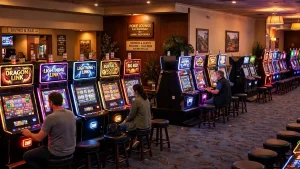
The phrase may describe a gaming-machine area or a brand label; by itself, it does...


































































































































































































