Online Pokies with E-Wallets in Australia: Legal Context
 Available in AU
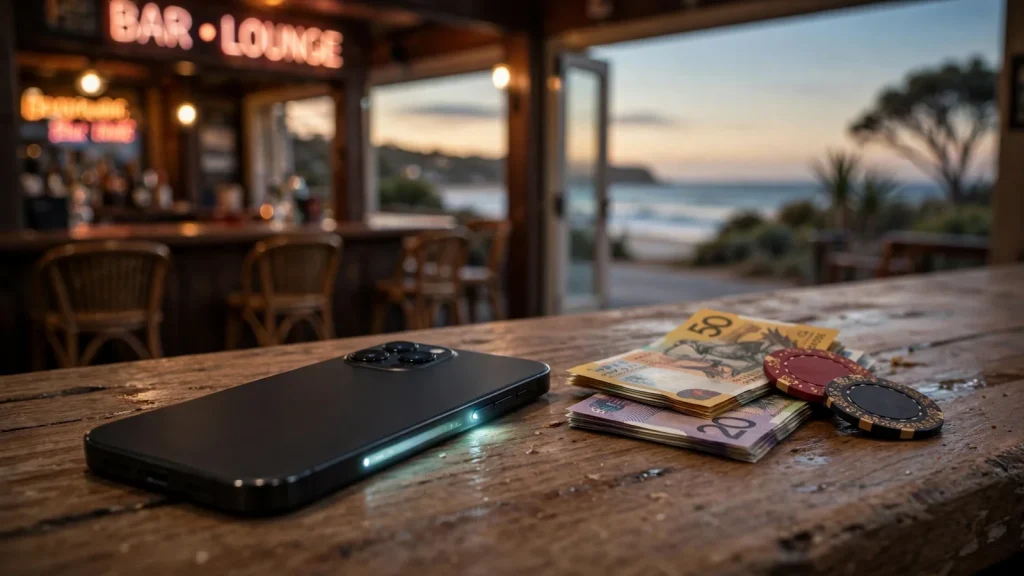
E-wallets affect deposits and withdrawals, but they do not change the legal position of offshore casino games or the checks around cashouts.
Table of Contents
- The Offshore Context Behind E-Wallet Pokies
- Browser Play, PWAs and the Login Experience
- What an Australian E-Wallet Casino Search Can—and Cannot—Show
- AUD Deposits and the Payment Routes That Still Matter
- New E-Wallet Pokies: What “New” Changes in Practice
- E-Wallet Casino Cashouts: Timing, Checks and Limits
- No-Deposit Offers and the Terms Behind the Headline
The Offshore Context Behind E-Wallet Pokies
An e-wallet does not change the legal status of online casino-style games in Australia. It is a payment method, not a licence or a legal workaround. The central distinction is between what the law says about operators and what it says about individual punters: under the Interactive Gambling Act 2001, an operator must not offer real-money online casino games to people physically located in Australia, while playing at an offshore mobile casino is not itself illegal for an Australian player under that Act.
That distinction matters because legality is often compressed into a misleading phrase such as “Australian-friendly”. In practice, the phrase may describe an operator’s willingness to accept registrations from the country; it does not mean the service is authorised to offer casino games here. Nor does a foreign licence turn an offshore casino into a locally regulated Australian service. The operator’s obligations and the player’s liability are separate questions.
The prohibition concerns the supply of the service. Casino-style games offered for money, including pokies, fall within the kind of interactive gambling service that the law restricts when provided to customers in Australia. The framework is aimed at operators, not at making an individual player’s use of an offshore casino a criminal offence under the Act. That is a narrow but important distinction: absence of player liability is not the same as Australian approval, oversight or protection.
For Australian players considering online pokies with an e-wallet, it is worth checking each casino’s available licensing and payment details before choosing. Use this list as a starting point, and confirm the current terms directly with the operator.
1. Golden Pokies
License: Curacao Golden Pokies is listed with a Curacao licence. No further operator details are provided here.
2. Playfina Casino
License: Curacao eGaming (Hollycorn N.V., since 2017) · Min. deposit: A$20-30 (depends on the offer) Playfina Casino is licensed by Curacao eGaming, with Hollycorn N.V. named as the operator since 2017. Its minimum deposit is A$20–30, depending on the offer.
3. LuckyVibe
License: Curacao Gaming Control Board OGL/2023/176/0095 (Hollycorn N.V.) LuckyVibe is associated with Hollycorn N.V. and holds Curacao Gaming Control Board licence OGL/2023/176/0095.
4. SkyCrown
License: Tobique Gaming Commission · Payout speed: crypto ~10-15 minutes, fiat 1-5 days · Min. deposit: A$30 SkyCrown is licensed by the Tobique Gaming Commission. Its stated payout speed is around 10–15 minutes for crypto and 1–5 days for fiat, with a A$30 minimum deposit.
5. JeetCity Casino
License: Curacao eGaming (Dama N.V.) JeetCity Casino is licensed by Curacao eGaming, with Dama N.V. named as the operator. No further operator details are provided here.
6. Lucky Dreams
License: Curacao · Min. deposit: A$20 (POLi) Lucky Dreams has a Curacao licence and a A$20 minimum deposit for POLi.
7. House of Pokies
License: international iGaming licence – jurisdiction not named in the source · Payout speed: PayID 1-24 hours · Min. deposit: A$30 (PayID from A$10) House of Pokies is described as holding an international iGaming licence, though the jurisdiction is not named. PayID payouts are stated as taking 1–24 hours; the minimum deposit is A$30, or A$10 when using PayID.
8. Vegaz Casino
License: Curacao OGL/2024/1335/0780 · Min. deposit: EUR 20 Vegaz Casino holds Curacao licence OGL/2024/1335/0780. Its stated minimum deposit is EUR 20.
9. Thor Casino
License: Curacao – Antillephone N.V. (Versus Odds B.V.) · Min. deposit: EUR 20 Thor Casino is licensed in Curacao through Antillephone N.V., with Versus Odds B.V. named. Its stated minimum deposit is EUR 20.
10. Wild Tokyo
License: Curacao · Payout speed: crypto 30-60 minutes, fiat 1-5 days · Min. deposit: A$10 Wild Tokyo has a Curacao licence and a A$10 minimum deposit. Its stated payout speed is 30–60 minutes for crypto and 1–5 days for fiat.
What an offshore licence does—and does not—mean
Offshore casinos may refer to a licence issued in Curaçao, by the Malta Gaming Authority, or in Gibraltar. Those are examples of jurisdictions associated with operators that accept Australian players. A licence from one of them is not an Australian casino licence, and it does not displace the Australian prohibition on operators providing online casino games to people here.
I have seen licensing language do a lot of work in marketing. “Licensed” sounds complete; the part left unstated is who issued the licence and what route exists for a customer in Australia if a dispute arises. A foreign regulator’s rules may apply to the operator, but that does not give the punter the same practical position as dealing with a local Australian authority. The label is not the whole arrangement.
There is also an access issue. The Australian Communications and Media Authority actively blocks access to illegal gambling sites. A site appearing in a browser at one time does not establish that it is authorised, permanently accessible, or supported by an Australian complaint process. Blocking can affect availability; it does not convert the service into a legal domestic casino.
This is why an e-wallet search can create a false sense of separation from the underlying service. The payment route may be distinct from the game site, but it does not change which operator is offering the games, where the punter is located, or which legal framework applies. The same goes for a mobile format: a small screen does not make the service a different category of gambling.
Real Money Pokies on Android in Australia
The practical gap if winnings are withheld
The most consequential difference for a punter is often not the wording of the licence but the route available when something goes wrong. If an offshore casino refuses to pay winnings, there is no Australian government body that can hear the complaint as a domestic casino dispute and compel the operator to pay. That leaves a practical gap between being able to use a service and having an effective local remedy against it.
An operator may have its own complaints process or refer to an overseas licensing jurisdiction. Those channels are not equivalent to an Australian government complaints body. The operator controls its internal process, while any external route depends on the rules and reach of the relevant foreign authority. A punter should not treat a logo, a licence statement or an e-wallet transaction record as a guarantee that a disputed balance can be recovered.
Age remains a separate threshold: a person must be at least 18 to register and gamble in Australia. That requirement does not resolve the offshore question. Being old enough to gamble does not make an offshore casino legally authorised to provide its service in Australia.
Responsible-gambling tools also need to be read as features of a particular operator, not as proof of local regulation. A specialist review describes controls such as deposit, loss and wager limits, session-time limits, and self-exclusion. Their presence and operation depend on the service. A menu of controls may be useful, but it does not supply independent Australian oversight or a remedy for withheld funds.
No Local Recourse
If an offshore casino refuses to pay winnings, there is no Australian government body that can compel the operator to pay.
The distinction is plain once the parts are separated: the Act restricts operators from supplying online casino games to people in Australia; it does not make an individual player’s offshore play illegal under that Act. Yet that does not make the activity locally approved or remove the practical risks of dealing with a business outside Australia’s complaints system. Legal status and recourse are different matters. A crucial difference.
Browser Play, PWAs and the Login Experience
On mobile, the ordinary route into an offshore casino-style site is a browser, not an app-store download. Casino apps are rarely listed in the Australian Google Play Store or Apple App Store, so a search there can produce a misleading comparison: social and free-play apps may be available, but they use virtual credits and are different from real-money services.
That distinction matters at login. A social app can be installed through an official store and used with its own account, while a real-money site may open in a mobile browser. Seeing familiar game imagery or an app icon does not establish that the product has the same account system, rules or function. The interface can look similar; the underlying service is not necessarily the same.
Browser access generally means signing in to the website with the account used on desktop. The mobile screen is a different view of that account, rather than a separate profile created just for the phone. This continuity can be useful, but it also means that an unfamiliar login page deserves care. A saved bookmark or a manually checked address is safer than following an unexpected message or advertisement to a page that imitates a sign-in screen.
$1 Minimum Deposit Pokies in Australia: What Works
A mobile browser may offer to save a password or keep a session active. Those settings are convenient on a device used privately, but less suitable on a shared phone or one that can be accessed by other people. A remembered session can expose an account even when no password is visible. Device locks, careful handling of saved credentials and signing out when access is shared are basic safeguards, not guarantees.
A Progressive Web App, or PWA, is not a separate native application in the usual sense. It is a shortcut to the casino website that opens in a format designed to resemble an app. If the site provides an install or “add to home screen” prompt, installation involves tapping it and confirming the action. The icon then provides a more direct route back to the website. It does not turn the service into an app vetted by an Australian app store.
That difference is easy to miss. A PWA still depends on the website and the operator behind it. If the site changes, becomes unavailable or has a problem with its login system, the shortcut cannot fix that. Nor does an app-like screen establish that the operator is legitimate, secure or permitted to offer real-money casino games in Australia. Presentation is not oversight.
Do
- Use a mobile browser to keep the address visible
- Add a PWA shortcut for simpler return visits
- Sign out of accounts when sharing a device
Don’t
- Trust a PWA icon as proof of official app store vetting
- Install unverified sideloaded apps from unsolicited links
- Use a VPN to bypass blocks, risking voided winnings
Sideloaded apps carry a separate risk. An installation file obtained outside an official store may ask for permissions or contain software that is difficult to assess. The safety of a casino app distributed this way depends on the operator and on the integrity of the file; the fact that it bears a recognisable logo is not a security check. I treat an unsolicited download link as a reason to stop, not as evidence that an app is the preferred route.
The practical choice is usually between opening the site in a browser and adding its PWA shortcut. Browser play avoids installing an unverified package and makes the address visible, though it does not remove the need to check that address. A PWA can make return visits simpler, but it remains tied to the same website and carries the same trust assumptions. Neither route guarantees uninterrupted access or protects account details by itself.
There is also a difference between an app-store listing and permission to offer real-money gambling. Social casino apps that use virtual credits are legal to use in Australia and can be downloaded from the major app stores. Real-money online casino games are treated differently under Australian law; an offshore site’s browser access or PWA does not change that position. Before any deposit, the site must confirm that it accepts the person’s location. Using a VPN to reach a blocked casino may lead to winnings being voided or an account being closed.
The access route says little about what happens if an offshore casino withholds winnings. There is no Australian government body that can hear a complaint and compel such an operator to pay. That is a material limitation, not a technical inconvenience. App-like access can make a service feel local and familiar. It is not local recourse.
$5 Minimum Deposit Pokies in Australia: Payment Limits
For an e-wallet account, the login itself is still the casino’s login; the wallet does not replace it. Keeping those credentials separate helps avoid treating a successful sign-in as proof that every part of the service is safe. The browser, shortcut and payment account each have different security implications. Convenient entry. Limited assurance.
What an Australian E-Wallet Casino Search Can—and Cannot—Show
A list of e-wallet pokies presented as relevant to Australia can show which payment names appear on a site’s cashier page. It cannot establish that the site will accept an Australian account, that the listed wallet can be used for every transaction, or that a punter will have a remedy if a dispute arises. Those are separate questions, and a neat comparison table can make them look like one.
MiFinity, Skrill and Neteller are examples of e-wallets used for both deposits and withdrawals at offshore casinos. Their appearance in a list is a starting point for checking the payment terms, not proof that the method works for a particular Australian customer. A payment logo may be displayed while access to the casino, or to that payment route, depends on location and account checks.
The location question comes first. A site appearing in search results, or describing itself as Australia-facing, does not confirm that it currently accepts people in Australia. The relevant information is the operator’s own eligibility wording and the registration process before any funds are sent. If the terms do not clearly establish that an Australian address is accepted, the listing cannot fill that gap.
This distinction matters because a directory is not the operator. It may describe a cashier or account feature without controlling the site’s eligibility rules, and those rules can change. The Australian Communications and Media Authority actively blocks access to illegal gambling sites, so a page being visible in a search result is not evidence that it will remain accessible. A result is a result. Not permission.
Attention: A payment logo on a site’s cashier page does not guarantee that the wallet will work for a specific Australian customer or that the site currently accepts Australian registrations.
There is also a difference between an Australian-facing list and an Australian-regulated service. A list may include offshore, crypto-friendly casinos, but that description does not create local oversight or guarantee access. Nor does it show whether an operator will resolve a complaint fairly. If an offshore casino withholds winnings, there is no Australian government body for the punter to complain to about recovering them. That is a practical limit of relying on a listing, not a detail that payment badges can answer.
Payment descriptions need the same scrutiny. A specialist review has reported that some casinos require a withdrawal to return through the method used for the deposit, while other methods may be deposit-only. That is not a rule to assume applies everywhere; the terms for the particular site and account matter. A list that labels an e-wallet “available” may omit this distinction, leaving the user to discover it only when trying to move funds out.
Even a clearly stated wallet option does not settle every question about the account. The site may impose conditions on who can register, and a payment method’s presence does not override those conditions. Using a VPN to reach a casino that blocks the location may lead to an account closure or voided winnings. A result that loads through a different connection is not evidence that the location restriction has been lifted.
The same caution applies to any comparison that ranks sites or presents a “best” choice. A ranking can compress several different claims—location acceptance, wallet availability, withdrawal eligibility and dispute handling—into a single label. That label is not a substitute for checking each point. It also cannot turn an offshore operator into a locally accountable one. A list is a filter, not protection.
$10 minimum deposit pokies in Australia: how it works
The most useful way to read an e-wallet list is therefore narrowly: it may help identify which payment names are mentioned, but it cannot verify current Australian eligibility or guarantee that deposits and withdrawals will follow the same route. The operator’s current terms must say whether Australian residents are accepted and how the chosen method is treated. If that information is unclear, the listing has not answered the essential question.
For an Australian punter, the distinction is material before any deposit. Search visibility does not mean an account can lawfully be served, will be accessible, or has a local complaints channel. An e-wallet label does not certify the casino, and a directory cannot promise payment. The gap remains.
AUD Deposits and the Payment Routes That Still Matter
Funding an account in Australian dollars is not a single, standardised process. A payment logo on a cashier page says that a route is presented there; it does not establish that the route will work with every Australian bank, that the balance will remain in AUD, or that the transaction will be handled the same way across offshore services. The cashier is only one part of the chain.
A specialist review describes PayID as a deposit route with near-instant processing and no fee in the service it assessed. That is a report about a particular offering, not a dependable rule for every casino or every transaction. PayID is a bank payment method, but a casino’s stated availability, the account’s instructions and the bank’s handling all matter. A punter should check the displayed payment details and any fee or currency information before authorising a transfer; a familiar payment name alone does not settle those details.
PayID is a bank payment method reported to have near-instant processing and no fees in certain assessed services, though this depends on the specific operator.
Bank-based routes and a discontinued option
PayID and BPAY are among the bank-linked methods that specialist casino reviews have reported seeing in mobile cashiers, alongside cards and cryptocurrency. The same review material describes different processing times across these routes, rather than one timing that can be applied to all of them. That distinction matters: a method can be technically available while its processing depends on the provider or the operator’s payment setup.
POLi needs a different treatment. Its Australian service ended in September 2023, so it no longer handles local payments. A cashier or comparison page that still presents POLi as a live Australian option may be carrying stale information. Its previous presence in Australian payment discussions is not evidence that a current transaction can be made through it.
BPAY and PayID should not be treated as interchangeable merely because both connect with bank payments. The practical point is to read the specific cashier terms rather than infer the mechanics from the method’s name. If the instructions do not clearly show how an AUD payment is sent and credited, the route remains uncertain.
Cards and declined payments
Cards can also appear among the mobile deposit options identified in specialist review material. A listed card route does not mean every card will be accepted. Specialist reviews report that some Australian banks block or flag gambling-related card charges, which can leave a deposit declined or held for review. That outcome may originate with the bank rather than with a fault in the cashier, and repeating the same attempt does not resolve the underlying restriction.
$20 Minimum Deposit Pokies in Australia
The word “card” also covers different products, so a generic card logo is not a useful answer to every question about eligibility. The relevant point is narrower: card acceptance can vary, and a cashier’s display does not override a bank decision. If a payment fails, the transaction record and the bank’s own explanation are more informative than assuming the account balance or game page caused it.
A failed card payment can be especially confusing when the cashier first shows the method as available. In practice, there are separate checks: the operator must offer the route, the payment processor must handle the transaction, and the bank must permit it. A break at any stage can prevent the deposit. “Available” is not “approved.”
Cryptocurrency and AUD value
Cryptocurrency is also reported as a mobile deposit route in specialist review material. It differs from a bank payment because the displayed value may be denominated in a digital asset rather than directly in Australian dollars. A punter comparing an AUD budget with a cryptocurrency cashier needs to establish how the amount is converted and what value the casino credits. The method’s appearance in a cashier does not answer those questions.
That is where the phrase “AUD e-wallet pokies” can obscure more than it clarifies: a payment route may be shown beside AUD figures without proving that every step of the transfer is settled in Australian currency. Before confirming any transaction, the cashier’s own currency display and payment instructions should make the amount and route intelligible. If they do not, the apparent AUD figure may not tell the whole story.
PayID & BPAY
Bank-linked methods with varying processing times depending on the provider.
Cards
Subject to potential blocks or flags by some Australian banks.
Cryptocurrency
Digital asset deposits where the AUD value depends on conversion and casino credit.
POLi
No longer handles local payments following the end of its Australian service in September 2023.
Across the options, the dependable comparison is not a universal speed ranking. Available methods and their processing can differ, and claims about speed or fees need to be tied to the particular service making them. PayID has been described favourably by a specialist review, but that report is not a market-wide promise. POLi is no longer a local payment route; card payments may be blocked by banks; and BPAY or cryptocurrency require attention to the instructions and currency shown. A payment logo is not a guarantee.
New E-Wallet Pokies: What “New” Changes in Practice
“New” is a label, not a quality check. It may describe a recently added payment option, a redesigned mobile page or simply a fresh marketing claim. It does not establish that a casino is newly launched, dependable, available in Australia or independently verified. In practice, the useful question is what changes for the punter: whether the site works on the device, whether access is permitted from the current location, and what happens if the service later disputes an account or payment.
The payment label alone tells little about the rest of the experience. A site can display an e-wallet alongside other payment choices without that information proving that every option is available to every visitor. The same applies to a “new” badge. It may signal an interface change rather than a change to the rules governing access or account use. Marketing language is easy to update. The conditions that matter are in the site’s own terms and operational notices.
$1 Minimum Deposit Casinos in Australia
A practical check starts before any deposit. The site must explicitly accept customers located in Australia, and that status should be checked in its current terms rather than inferred from Australian currency, local-looking pages or an ability to open the homepage. Offshore sites can appear online even when access is restricted. An Australian-facing page is not proof of permission to register or play from Australia. Nor does the presence of a payment logo settle the question.
This distinction matters because online casino-style games cannot lawfully be offered to people in Australia by operators under the Interactive Gambling Act 2001. ACMA blocks access to illegal gambling sites. A foreign licence or an Australian dollar display does not turn an offshore service into an Australian-regulated casino. Any offshore crypto-friendly casino discussed in this context remains offshore; crypto support is a payment feature, not a sign of Australian approval.
A VPN is not a sound workaround for a blocked site. It can conceal or alter the apparent location, but it does not make the underlying access permitted. If an operator treats VPN use as a breach of its terms, it may close the account or void winnings. That risk is not confined to the moment of registration: location checks can matter later, including when an account is reviewed. A connection that works today is no assurance that the operator will honour a balance tomorrow.
Mobile reliability is another part of the “new” claim that is rarely visible in a banner. A specialist review identifies weak connections, limited device memory, outdated browsers and too many apps running in the background as common causes of mobile casino problems. Those are ordinary technical failure points, not evidence that a new payment option has failed. A page freezing during a game may reflect the device or connection rather than the wallet itself.
Before Depositing
- Check the current terms for explicit acceptance of Australian residents
- Verify if the site is accessible without a VPN
- Confirm that the operator’s account rules explain access blocks
- Test connection stability and browser updates on the mobile device
I have seen how quickly those different issues get bundled together in a complaint: the screen stalls, a session ends, and the punter assumes the payment method caused it. That assumption can waste time. First separate account access from payment processing and device performance. If the site loads inconsistently, test whether the problem persists after closing other apps, restoring a stable connection or updating the browser. These steps diagnose the phone; they do not establish that the casino is safe or entitled to serve Australian customers.
The operator still controls the service. A smooth mobile screen cannot prove that its location rules are clear, and a wallet icon cannot prove that a disputed balance will be paid. Offshore licensing may exist in jurisdictions such as Curaçao, Malta or Gibraltar, but a foreign licence is not Australian recourse. If an offshore casino withholds winnings, there is no Australian government body to complain to for resolution. That is the hard boundary behind any feature list.
For a new interface, the useful evidence is consistency: whether the terms match the registration screen, whether Australia is included in the permitted locations, and whether the operator’s account rules explain what can happen when access is blocked. A polished launch page can make a service feel established before its everyday processes have been tested. It cannot remove the need to confirm the location rule before depositing, or change the consequences of using a VPN against the operator’s restrictions.
“New” may mean a changed button, a refreshed layout or a payment route newly shown on the page. It does not mean newly trustworthy. Check the mechanics, not the adjective.
$2 Minimum Deposit Casinos in Australia: What to Know
E-Wallet Casino Cashouts: Timing, Checks and Limits
A cashout is not one event. It moves through identity checks, the casino’s internal pending period and the payment provider’s processing. The displayed status can therefore say “approved” before the money reaches an e-wallet. When I assess a stated payout time, I separate those stages; combining them makes a short estimate look more certain than it is.
For offshore, crypto-friendly casinos, the distinction matters because the operator controls the first stages, while the e-wallet or bank handles the final transfer. An Australian punter also has no Australian government body to complain to if an offshore casino refuses to pay winnings. A payment label is not protection against that outcome.
Verification comes first
A first withdrawal commonly triggers KYC checks. The casino may ask for identification, a selfie and proof of address. These checks are used to match the account holder to the submitted documents and confirm account details. If a file is unclear, incomplete or inconsistent, the casino may ask for another document, adding time before the withdrawal can move forward.
I treat verification as a separate stage, not as part of the e-wallet’s delivery time. A casino can describe the payment method as fast while leaving the time needed to review documents out of the headline. The practical question is when the request enters processing, and whether the account has already passed verification.
Pending is not payment processing
After approval, some casinos keep a withdrawal in a pending state before sending it. During this interval, the request remains with the casino rather than the e-wallet. A countdown that begins only after the pending period will not capture the full wait from request to receipt.
Cashout Sequence
Step 1: Verification
The casino conducts KYC checks, requiring identification, a selfie, and proof of address.
Step 2: Approval and Pending
The casino approves the request and may hold it in a pending state for a set interval.
Step 3: Transfer and Receipt
The funds are sent via the payment route (e.g., e-wallet) and arrive in the user’s account.
A specialist review reports that e-wallet withdrawals arrive within 24 hours after the casino’s pending period. That is a reported timing, not a service guarantee for every operator or transaction. A separate specialist review describes crypto and e-wallet withdrawals as being processed in under 24 hours, but “processed” does not necessarily mean funds are already available to use. The distinction is easy to miss. Processing and receipt are different clocks.
For an e-wallet cashout, the useful sequence is therefore: verification, casino approval, any pending interval, then transfer and receipt. The status shown in an account may help identify where a delay sits, but it does not by itself establish that the funds have arrived.
Bank transfers and withdrawal caps
Bank transfer timing is a different comparison. A specialist review gives a possible withdrawal period of up to five business days for bank transfers. That estimate applies to the bank route, not the casino’s verification or pending stages; those may come before the transfer begins. Business-day processing also means a request can cross a weekend without the calendar wait matching the number of processing days.
$5 Minimum Deposit Casinos in Australia
Limits can affect the path as much as timing. Some casinos set weekly or monthly withdrawal caps. A specialist review places some weekly caps in the $4,000–$10,000 range, but the applicable figure depends on the casino’s terms. If a balance exceeds a cap, payment may be split across periods rather than issued in one transfer. The cap should be checked alongside any per-transaction rule, since the two can shape how much is released at once.
The operational detail is in the sequence: cleared identity checks, release from pending status, then the payment route’s own delivery time. A fast e-wallet estimate only describes part of that chain.
No-Deposit Offers and the Terms Behind the Headline
A “no-deposit” label describes how an offer begins, not what can be withdrawn. The attached rules determine whether any resulting balance can become cashable, and an e-wallet does not change those rules. I have seen the headline do its job before the conditions are read. That is the point of the headline.
Real Money Pokies in Australia: App or Browser?
A specialist review describes welcome-bonus wagering requirements in the range of 30x to 50x the bonus amount; that is a reported range, not a rule applying to every offer. The multiplier matters because it sets how much qualifying play must be recorded before withdrawal eligibility. A specialist review treats requirements above 40x as steep. The calculation may also apply to a bonus, a deposit, or both, so the wording beside the multiplier matters as much as the number.
Deposit conditions can quietly alter the apparent value of an offer. A bonus described as requiring no initial payment may still carry a later deposit condition before winnings can be withdrawn, or may be unavailable unless particular account conditions are met. The minimum deposit, if one is specified, belongs in the calculation alongside the wagering requirement. If the condition cannot be met on the intended terms, the advertised balance is not useful cash.
No Minimum Deposit Casinos in Australia: How It Works
Time limits create another pressure point. The rules may set a period for completing wagering, after which the bonus or related winnings expire. A short deadline can make a large requirement harder to clear without changing the headline. Game restrictions matter too: not every game may contribute equally, and some may be excluded from wagering altogether. A balance that appears to move while playing can therefore make little progress against the requirement.
Cashout caps put a ceiling on what can be withdrawn from bonus-related play, even if the wagering condition has been completed. The cap is separate from the balance shown on screen. Read it before claiming, not after a winning session.
Before claiming any offer, check the wagering requirement, eligible games and contribution rules, expiry date, deposit conditions and cashout cap. If the terms are unclear or the conditions do not fit, declining the offer avoids taking on rules that are difficult to unwind. Keep the decision separate from the excitement of the headline. Terms first.
Can I play for free at Australian mobile casinos?
Yes. Social and free-play casino apps with virtual credits are available through the Australian Google Play Store and Apple App Store; they are different from real-money casino services.
Is it safe to play at mobile casinos in Australia?
Offshore casinos do not have the same local oversight or complaint route as an Australian-regulated service. If a casino withholds winnings, there is no Australian government body that can compel it to pay.
Is browser play or an app easier for most players?
Browser play is the usual option, since casino apps are rarely listed in Australian app stores. Some sites offer a PWA, which can be added to a device’s home screen and behaves like an app.
Do mobile casinos offer bonuses?
Yes. Welcome bonuses commonly have wagering requirements of 30x to 50x, and many must be cleared within 7–10 days.
Can I use PayID at Australian casino apps?
PayID is available as a deposit method at some mobile casinos, with near-instant processing and typically no fee.
Can players limit their losses on mobile casinos?
Yes. Available responsible-gambling controls can include loss limits, deposit and wager limits, session-time limits, and self-exclusion.
Mobile Casinos

$1 Minimum Deposit Casinos in Australia
The advertised account minimum can differ from the payment method’s transaction floor, so a $1...

$1 Minimum Deposit Pokies in Australia: What Works
A deposit screen’s minimum is only one rule; payment routes, bonus terms and withdrawal conditions...

$10 Minimum Deposit Casinos in Australia
The operator’s stated minimum may differ from what a payment route can process, while bonus...

$10 minimum deposit pokies in Australia: how it works
A casino’s own deposit settings may differ from the minimum imposed by the payment method...

$2 Minimum Deposit Casinos in Australia: What to Know
A low advertised threshold does not guarantee a completed transaction, because payment channels can set...

Australia $20 Minimum Deposit Casinos and Payment Rules
A $20 starting point depends on the casino’s terms and the payment method, with fees,...

$20 Minimum Deposit Pokies in Australia
An operator’s cashier limit and a payment method’s transaction threshold can differ, so the amount...

$5 Minimum Deposit Casinos in Australia
A stated operator minimum can differ from the payment method’s transaction floor, changing whether a...

$5 Minimum Deposit Pokies in Australia: Payment Limits
The operator’s advertised threshold and a payment provider’s minimum are separate limits, so the available...

Australian Mobile Casinos: Sites, Apps and Risks
A practical guide to browser-based access, offshore-market caveats, payment friction, bonus terms and the limits...

Android Casino Apps in Australia: Legal and Payment Guide
In Australia, casino-style services are prohibited for operators, while mobile access, payments and cashouts bring...

Casino Apps for iPhone in Australia: How They Work
In Australia, iPhone pokies are commonly accessed through a casino’s mobile website, with account, payment...

Casino Apps in Australia: Mobile Access Guide
In Australia, the label may mean a mobile site or PWA, with practical differences in...

Instant Withdrawal Casinos in Australia: What to Know
A practical look at mobile access, payment methods, verification and bonus rules behind offshore casino...

International Casinos for Australian Players: What to Know
A practical guide to offshore access, legal boundaries, bonus terms, mobile play and payment trade-offs...

Best Offshore Casinos for Australian Players: A Guide
The guide distinguishes browser sessions, PWAs and native apps while examining legal responsibility, offers and...

Inclave Casinos in Australia: Access and Legal Limits
An Inclave login can authenticate an account, but it does not establish a casino’s licence,...

iPad Casinos in Australia: Rules and Play
An iPad affects the interface, while legality, free-play claims, bonuses and payments depend on separate...

Low Deposit Online Casinos in Australia: How They Work
A practical guide to minimums, payment routes, bonus turnover and the conditions that affect withdrawals....

No Minimum Deposit Casinos in Australia: How It Works
An operator may set no deposit floor, but the payment route has its own requirements...

Online Pokies in Australia: No-Deposit Real-Money Offers
The guide separates real-money promotions from free play and explains why offer labels, game claims...

Real Money Pokies on Android in Australia
Compare browser access, native apps and Progressive Web Apps, and see how free-play credits differ...

Real Money Pokies in Australia: App or Browser?
See how browser play and PWAs work, and what the article covers about bonuses, deposits...