
Solana Casino Comparison for Australian Players
 Available in AU
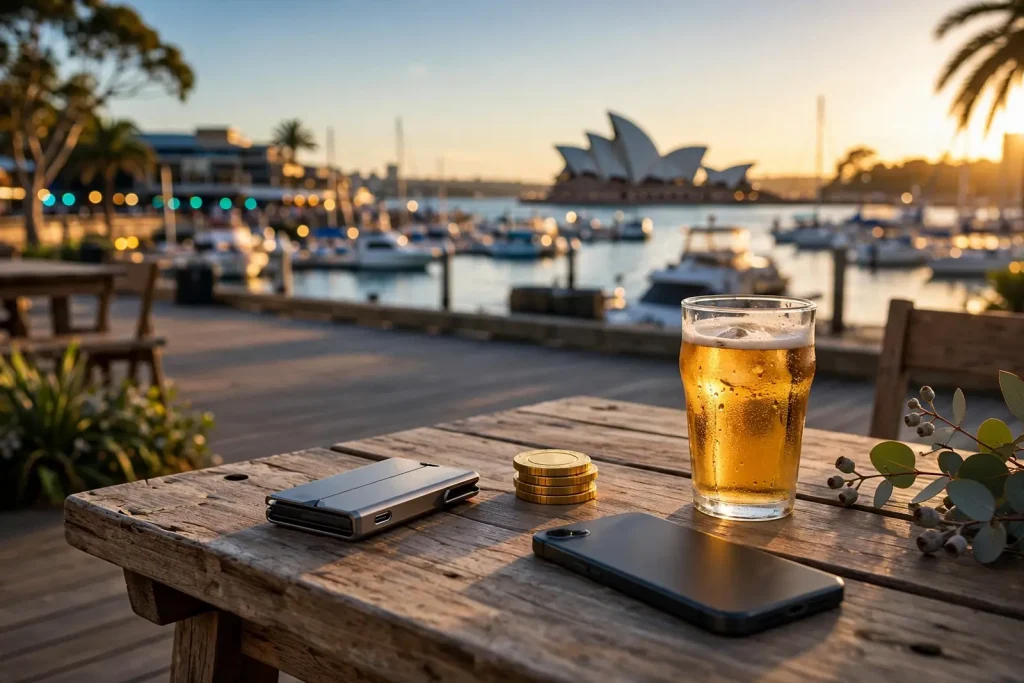
A practical guide to exchange transfers, offshore casino limits, bonus playthrough and the trade-offs of using SOL.
Table of Contents
- How Solana Casinos Work for Australian Players
- What a Solana Casino Comparison Can—and Cannot—Establish
- The Australian Legal Position on Offshore Solana Casinos
- Solana Slots and the Cost of Bonus Playthrough
- NFT Claims, SOL Deposits and Other Tokens
- Crypto Gambling and Australian Tax Treatment
- Dice Games on Solana: The Network Fee Is Not the House Edge
- Casino Games, Bonus Terms and Effective Value
- What SOL Adds to Casino Payments
- Minimum Deposits and the Risk of a Mis-Sent Transfer
How Solana Casinos Work for Australian Players
The payment route is usually not a direct AUD deposit. Most offshore Solana casinos do not take Australian bank transfers or card payments into a gambling balance. Instead, the route runs through an exchange: AUD is deposited there, converted to SOL, then sent to the wallet address shown by the casino. The exchange account and the casino balance are separate steps, with a transfer between them.
Australian exchanges including Swyftx, CoinSpot and Coinbase AU support AUD funding by PayID or bank transfer. The exchange may require KYC checks as part of its identity and anti-money-laundering obligations before allowing a purchase or withdrawal. That check belongs to the exchange, not the casino. A completed identity check at one service should not be treated as approval or verification at the other.
Once SOL is bought, the exchange’s withdrawal screen is where the transfer is prepared. The receiving address must match the casino’s deposit address, and the asset and network selected must be compatible with it. A copied address is not a substitute for checking the destination: SOL transfers are irreversible, and a transfer sent to the wrong address can be lost permanently. There is no ordinary bank-style reversal process.
Choosing a Solana casino in Australia calls for checking the available licensing and payment details before deciding where to play. This reference highlights the specific information available for each listed operator.
1. Golden Pokies
License: Curacao Golden Pokies is listed with a Curacao licence. The available details do not specify other operator features.
2. Playfina Casino
License: Curacao eGaming (Hollycorn N.V., since 2017) · Min. deposit: A$20-30 (depends on the offer) Playfina Casino is licensed by Curacao eGaming under Hollycorn N.V., which has held the licence since 2017. Its minimum deposit is A$20–30, depending on the offer.
3. LuckyVibe
License: Curacao Gaming Control Board OGL/2023/176/0095 (Hollycorn N.V.) LuckyVibe is licensed by the Curacao Gaming Control Board under OGL/2023/176/0095, with Hollycorn N.V. named as the licensee.
4. SkyCrown
License: Tobique Gaming Commission · Payout speed: crypto ~10-15 minutes, fiat 1-5 days · Min. deposit: A$30 SkyCrown is licensed by the Tobique Gaming Commission. Its stated payout times are around 10–15 minutes for crypto and 1–5 days for fiat, and its minimum deposit is A$30.
5. JeetCity Casino
License: Curacao eGaming (Dama N.V.) JeetCity Casino is licensed by Curacao eGaming, with Dama N.V. named as the licensee.
6. Lucky Dreams
License: Curacao · Min. deposit: A$20 (POLi) Lucky Dreams is listed with a Curacao licence and a minimum POLi deposit of A$20.
7. House of Pokies
License: international iGaming licence – jurisdiction not named in the source · Payout speed: PayID 1-24 hours · Min. deposit: A$30 (PayID from A$10) House of Pokies has an international iGaming licence, though the source does not name its jurisdiction. PayID withdrawals are stated to take 1–24 hours, and PayID deposits start at A$10, with a general minimum deposit of A$30.
8. Vegaz Casino
License: Curacao OGL/2024/1335/0780 · Min. deposit: EUR 20 Vegaz Casino is listed under Curacao licence OGL/2024/1335/0780. Its stated minimum deposit is EUR 20.
9. Thor Casino
License: Curacao – Antillephone N.V. (Versus Odds B.V.) · Min. deposit: EUR 20 Thor Casino is licensed in Curacao through Antillephone N.V., with Versus Odds B.V. named in the licence details. Its minimum deposit is EUR 20.
10. Wild Tokyo
License: Curacao · Payout speed: crypto 30-60 minutes, fiat 1-5 days · Min. deposit: A$10 Wild Tokyo is listed with a Curacao licence and a minimum deposit of A$10. Its stated payout times are 30–60 minutes for crypto and 1–5 days for fiat.
That point is easy to underestimate because the exchange interface makes sending crypto look like another routine payment. It is not. The casino’s displayed address is the destination, while the exchange is the sender; neither label changes the finality of the transaction. A transfer should not be initiated until the address and transfer details have been checked against the casino’s instructions.
After the network transfer, the casino has to recognise the incoming funds and credit the account. The balance shown on the casino site is therefore not the same thing as an AUD balance in an Australian bank account. It is a crypto-denominated balance, and its value in Australian dollars can move with SOL’s price. A win expressed in SOL may be worth less in AUD by the time it is withdrawn if the market price falls. The payment route carries price exposure as well as transfer risk.
The reverse route begins with a withdrawal request at the casino. If it is approved, SOL is sent to a wallet or exchange account controlled by the player, then sold for AUD and withdrawn through the exchange’s available cash-out method. The conversion and cash-out stages are separate from the casino’s approval. A successful on-chain transfer does not itself mean the proceeds have reached a bank account.
Withdrawal timing has two clocks: the operator’s internal processing and the blockchain transfer. A specialist review reports that automated operators may process requests in 5–15 minutes, while manual handling can take as long as 72 hours. Those are not network guarantees; they describe differences in how an operator handles a request before sending it. Some casinos also impose their own withdrawal charge, with a specialist review reporting fees between 0.1% and 1% of the amount. The stated charge should be distinguished from any exchange conversion cost or cash-out charge.
Under-One-Hour Casino Withdrawals in Australia
The casino may also require KYC checks when a withdrawal is requested, particularly for a larger amount or a bonus-related cashout. That can mean providing identity documents before funds are released. The account may appear funded before this point, but that does not establish that a later withdrawal will be immediate or unconditional. Cash-out terms are worth reading before depositing, not after a balance has built up.
There is a legal boundary around the route, too. Australians may buy and transfer SOL, but the Interactive Gambling Act 2001 bars offshore operators from supplying real-money online casino services to people in Australia. The restriction is directed at the operator; it does not make an offshore casino payment legally safe for the player. Offshore platforms also sit outside the protections available through Australian authorities if an account is frozen or funds are withheld.
A VPN does not solve the practical or legal problem. Using one may breach an operator’s terms and can lead to account seizure and loss of funds. Nor does an exchange transfer turn a casino balance into a protected bank deposit. The exchange handles the AUD-to-SOL leg; the offshore operator controls whether it credits, holds or releases the casino balance.
Legal Risk
Under the Interactive Gambling Act 2001, offshore operators are prohibited from providing real-money online casino services to people in Australia.
From the counter, the important distinction is between a payment that has left an exchange and money that is available to withdraw from a casino. Each stage has its own checks, price exposure and failure points. The chain is simple on paper. The hand-offs are not.
What a Solana Casino Comparison Can—and Cannot—Establish
A comparison can organise evidence; it cannot turn an offshore casino into a locally regulated service or guarantee that a balance will be paid. I separate what can be checked from what is merely asserted. That distinction matters because polished pages often place a confident licensing badge beside a payment promise, as though one proves the other. It does not.
Treat licensing language as a claim to verify
There is no specific Australian licensing framework for crypto-gambling operators in place as of mid-2026, according to a specialist review. That statement should not be stretched into a claim that an offshore authorisation gives an operator Australian approval. The Interactive Gambling Act 2001 prohibits offshore operators from providing online casino games to people in Australia. A comparison should therefore describe any licence accurately, including the issuing jurisdiction and what the licence covers, rather than presenting a foreign licence as local protection.
The same caution applies to phrases such as “regulated,” “approved” or “fully licensed.” Those words can refer to different things, and a badge alone establishes little. The useful questions are concrete: which authority issued the document, can the details be checked against that authority’s records, and does the stated permission cover the service being offered? If those points cannot be established, the comparison should label the claim unverified rather than convert it into reassurance.
EcoPayz Casino Sites in Australia: What Is Verified · Casino Sites That Accept Credit Cards in Australia
This is a framework for reading claims, not a recommendation to choose an operator with a particular badge. A platform can present documents and still leave Australian customers with limited practical recourse if a dispute arises. Offshore use is not legally safe merely because there has been no known prosecution of an individual player. Nor does a comparison make an offshore service lawful for Australian residents.
Read payout procedures as separate stages
A withdrawal estimate is not a single measure of speed. The casino has its own review and release process; after release, the blockchain transaction must be processed. Withdrawal timing can therefore depend on internal handling as well as network congestion. A comparison that gives one headline time without explaining which stage it measures is not giving a complete account.
Look for the stated steps between requesting a cash-out and seeing funds arrive: whether the request is reviewed, what status updates are provided, and what conditions can pause processing. A published procedure is evidence of what the operator says it will do, not proof that every request will follow that path. The point is to identify where discretion sits. An automated release and a request held for manual review are different experiences, even when a page describes both as “fast.”
Do
- Verify the issuing authority of a licence
- Read cash-out terms before depositing
- Check if a procedure is published
Don’t
- Trust a badge without verification
- Assume a headline withdrawal time is guaranteed
- Treat “quick payout” labels as evidence
KYC checks also belong in this assessment. A casino may ask for identity documents when a withdrawal is requested, including for a larger cash-out or a bonus-related withdrawal. The comparison should say when checks may occur, what documents are requested and whether the rules explain how an account is handled while a review is pending. No review can promise that checks will never happen. Separate from the casino’s rules, services that convert SOL into Australian dollars have their own identity and anti-money-laundering obligations.
The practical detail is in the conditions. Read cash-out terms before depositing, not after a win. If the rules are difficult to find, change between pages or leave the effect of a review unclear, that uncertainty is itself relevant. “Quick payout” is a label. The procedure is the evidence.
Judge the comparison, not just its verdict
A useful comparison states what it checked and what remains unknown. It should distinguish confirmed details from operator statements, explain how the withdrawal procedure was assessed, and identify whether KYC rules are published. A star score or “best” label compresses those questions into a conclusion that may conceal gaps. The best Solana casino for one person cannot be established by a ranking if the underlying terms are not transparent.
I have seen comparisons treat a working deposit method as if it proved the whole account was dependable. It proves only that a payment route worked at that point. It says nothing by itself about later withdrawal decisions, account reviews or dispute handling. A comparison should not let one successful step stand in for evidence about another.
Instant Bank Transfer Casinos in Australia: How They Work
There are also risks no score can remove. SOL’s price can move between deposit and withdrawal, reducing the Australian-dollar value of winnings. Transfers cannot be reversed; sending SOL to the wrong address can mean permanent loss. A VPN may breach an operator’s rules and lead to account seizure and lost funds. Offshore operators offer limited consumer protection, and Australian authorities may not be able to recover funds if a platform withholds them or closes.
Those are not footnotes to a ranking. They define what the ranking cannot promise. A careful comparison can make claims easier to test and expose missing terms. It cannot establish that an offshore casino is safe under Australian law, or that a particular withdrawal will be approved. The boundary is important.
The Australian Legal Position on Offshore Solana Casinos
The legal distinction is between holding SOL and using an offshore casino that accepts it. Australians may legally buy, hold and transfer SOL. That does not make real-money online casino services lawful for operators to provide to people in Australia. Under the Interactive Gambling Act 2001, overseas operators are prohibited from offering online casino games to Australian residents.
The rule concerns the service, not the token used to fund it. A casino does not escape the restriction by denominating play in SOL rather than Australian dollars. Nor does describing a site as a Solana casino change the legal character of its offering. The relevant point is that the operator is providing online casino gambling to people physically in Australia.
The Interactive Gambling Act 2001 prohibits offshore operators from offering services, but the restriction is directed at the operator rather than penalising the individual player.
That makes the position easy to misread. The use of SOL at an offshore site is often described as a legal grey area, but that phrase should not be taken to mean the operator has permission to serve Australian residents. The Act places the prohibition on the operator. Australian players are not directly penalised simply for using such a site; the legal exposure described here is not a player fine or prosecution. Still, absence of a direct penalty is not approval, and it does not make the arrangement legally safe.
Enforcement and access
The Australian Communications and Media Authority (ACMA) enforces the Act, including by blocking unlicensed offshore gambling websites. A site remaining visible or accessible at a particular moment is not evidence that it is authorised to offer casino games in Australia. Blocking is an enforcement measure; it does not turn an offshore operator into a locally regulated business.
This distinction matters because access can be mistaken for legitimacy. In practice, the site may accept a player’s funds while Australian law prohibits the operator from providing the underlying service. A specialist review has reported that Australia had not established a specific licensing framework for crypto-gambling operators by mid-2026. That observation should be treated as a dated report, not as a licence category or assurance that a platform complies with Australian law.
There is no local casino licence that can be inferred merely from a site’s crypto focus, its use of Solana, or its claims about oversight elsewhere. A foreign licence, if an operator advertises one, does not remove the Australian prohibition on offering online casino services to residents. “Licensed” is a narrow claim about an operator’s stated status in a jurisdiction; it is not proof of permission to serve Australia.
Bitcoin Casinos in Australia: Rules and Payments
The gap in player protection
The practical weakness appears when a dispute turns into a loss. If an offshore casino freezes an account or withholds winnings, players using it have no legal protection under Australian law for recovering those funds. Australian authorities do not provide the consumer recourse that would apply to a locally authorised gambling service. The operator may be outside the effective reach of Australian complaint processes, leaving a player dependent on the site’s own handling of the dispute.
That is more consequential than the label “grey area” suggests. The player may not be directly penalised under the Act, yet can still face an inaccessible operator and no Australian remedy when money is withheld. These are separate questions: whether the player is punished, whether the operator may lawfully offer the service, and whether a player can recover funds. The answers are not interchangeable.
Using a VPN does not solve the legal problem. It may also breach an operator’s terms and lead to an account seizure or loss of funds. No shortcut changes the underlying restriction. The legal risk sits with the service provider; the financial and practical exposure can still land on the player.
Solana Slots and the Cost of Bonus Playthrough
A slot bonus is not simply extra balance. Its value depends on what the terms require before any resulting funds can be withdrawn. In my experience, the headline offer gets attention; the conditions determine whether the balance can become cashable.
Attention A large bonus can create substantial wagering requirements without creating equivalent cash value.
Slots typically count fully toward wagering requirements. That means each eligible bet contributes its full amount to the required turnover. The same is not necessarily true of other games: blackjack and roulette may count for only a fraction of a bet. For a slot-focused bonus, full contribution can make the stated requirement easier to complete than it would be through games with reduced contribution. It does not remove the requirement.
The distinction between bonus funds and withdrawable funds matters. Winnings generated from bonus funds must be wagered with real money before withdrawal. A balance can therefore look substantial on screen while remaining subject to conditions. The operator’s wording may also define which bets qualify, when the requirement expires, and what happens if the bonus is cancelled. Those details are part of the offer, not small print in any practical sense.
Free spins need separate scrutiny. Their winnings may be credited as bonus funds rather than as immediately withdrawable cash, and a separate wagering condition may apply. One specialist review gives a 50x requirement as an example for free-spin winnings; that figure is an illustration, not a standard that can be assumed across Solana casino offers. The operative terms are the ones attached to the specific promotion.
The arithmetic is easy to overlook. A 40x requirement on a 5 SOL bonus means 200 SOL in bets before withdrawal, if the requirement applies to the bonus amount. That is turnover, not a sum paid to the player, and it does not mean the original bonus will survive the play. Each wager remains exposed to the game’s outcome. A “large” bonus can therefore create a substantial amount of required play without creating equivalent cash value.
Instant PayID Withdrawals for Real Money in Australia
I have seen bonus language do its work through definitions: whether the multiplier applies to the bonus alone or to the deposit and bonus together, whether slot play counts fully, and whether free-spin winnings sit under another rule. A percentage contribution is not a promise of profit. It only describes how qualifying bets are counted.
Cash-out conditions belong in the decision before a deposit, not after a winning session. Larger withdrawals or bonus cashouts may trigger KYC checks requiring identity documents. SOL’s price can also move between deposit and withdrawal, reducing the AUD value of winnings even when the token balance is unchanged. An offshore operator remains outside Australian consumer protections if it withholds funds.
The useful figure is not the advertised bonus. It is the amount of eligible slot play required, under the exact terms, before the balance can leave the account. Read that first.
NFT Claims, SOL Deposits and Other Tokens
NFT language can make a casino sound more integrated with Solana than its payment options show. A site may use NFT imagery or describe itself as an NFT casino, but that wording alone does not establish that NFTs are part of its games, rewards, account access or deposits. Those are separate claims, each requiring its own clear explanation. I keep the distinction simple: branding is not a payment feature.
Supported Tokens
Some Solana casinos accept USDC on Solana for deposits and play alongside SOL, though this does not imply NFT functionality.
The payment detail reported in a specialist review is narrower: some Solana casinos accept USDC on Solana for deposits and play, alongside SOL. That does not mean every site supports both tokens, or that support for USDC implies any NFT functionality. The relevant question is what the casino actually accepts and credits to its balance, not what its promotional language suggests.
SOL and USDC also represent different kinds of exposure. SOL’s market price can move between a deposit and a withdrawal, reducing the Australian-dollar value of funds or winnings. USDC is designed as a stablecoin, but the fact that a casino accepts it does not settle questions about conversion, custody or withdrawal terms. A token name on a payment page is only the beginning of the check.
NFTs can refer to distinct things: a collectible, a token used to represent ownership, or simply a theme in a website’s presentation. None of those meanings should be inferred from a general “NFT casino” label. Before treating an NFT claim as functional, the operator would need to explain what the NFT does, how it is acquired or used, and whether it changes the player’s balance or rights. Without that detail, the claim should not be treated as a feature.
There is a more basic issue for Australian residents. The Interactive Gambling Act 2001 prohibits offshore operators from providing online casino games to people in Australia. Using SOL, USDC or an NFT does not alter that restriction. Offshore casinos also leave players without Australian legal recourse if funds are withheld or a platform closes. A crypto payment does not make the arrangement legally safe.
Instant PayID Withdrawals in Australia
Operationally, transfers of SOL are irreversible: a payment sent to the wrong address can be lost permanently. SOL’s price volatility can also affect the value of winnings before they are withdrawn. Larger withdrawals or bonus cashouts may trigger KYC checks requiring identity documents, so withdrawal conditions should be understood before any deposit. Using a VPN may lead to an account being seized and funds lost.
I have seen marketing blur the line between a token accepted at checkout and a feature built around that token. The distinction matters. A casino with Solana payments may accept SOL, and some may also accept USDC on Solana; neither fact establishes NFT-based play. Read the payment and cash-out terms as separate terms, and treat NFT language as descriptive until its practical role is stated plainly.
Crypto Gambling and Australian Tax Treatment
Australian tax treatment can look contradictory at first: recreational gambling winnings are generally not taxable, yet a win made using SOL can still have a tax consequence. The distinction is between the gambling result and the cryptocurrency used to place the wager. The Australian Taxation Office (ATO) regards cryptocurrency as an asset for capital gains tax purposes, and profits from gambling with SOL are subject to capital gains tax.
Tax Distinction
Recreational gambling winnings are generally not taxable, but profits from gambling with SOL are subject to capital gains tax.
That means the ordinary rule for recreational winnings does not settle the tax position when crypto is involved. A SOL balance is not simply cash held in a different format. Its treatment as an asset matters, so a gambling profit involving SOL may have a capital gains consequence even where the activity itself is recreational. The two ideas need to be kept separate.
I have seen promotional language collapse them into one claim: “tax-free” can sound like a blanket description of every amount won. It is not. The general treatment of recreational gambling winnings does not erase the ATO’s treatment of cryptocurrency as an asset. Nor does the fact that a casino displays a balance in SOL determine how that balance is treated for tax purposes.
Losses require care as well. A specialist tax commentary characterises the ability to offset gambling losses against gains as limited to people recognised as professional gamblers, a status it describes as difficult to establish. That is not a general route for recreational players to net losses against winnings. It is a separate and demanding classification, not something created by frequent play or by using a crypto casino.
The practical point is that “recreational” and “crypto” answer different questions. The first concerns how gambling winnings are generally treated; the second concerns the asset used and the potential capital gains tax consequences of gambling with it. Treating all activity as one category can miss that distinction.
For anyone keeping records, the relevant issue is not only the amount credited by an offshore platform but also the fact that SOL is an asset under the ATO’s approach. Tax outcomes depend on the circumstances, so a general statement about gambling winnings should not be taken as a complete answer for a SOL-based wager.
New PayID Pokies in Australia: Payment Guide
Separate categories. Different tax treatment.
Dice Games on Solana: The Network Fee Is Not the House Edge
A Solana transaction fee and the cost of a dice wager belong to different parts of the transaction. The network fee pays for processing an on-chain action; it does not describe how a casino game is priced, what the odds are, or how much a player might lose. Treating a near-zero fee as evidence of a low-cost game confuses payment infrastructure with gambling risk.
The average Solana transaction fee is about US$0.00025. That is a network charge, not a measure of the casino’s margin. A game can involve a tiny blockchain fee and still carry substantial financial risk. Without reliable information about a particular game’s rules and odds, the fee cannot establish its expected cost or fairness.
That distinction matters in searches for dice games associated with Solana casinos. The label identifies a payment environment, not a verified feature or a quality standard. A low fee does not prove that a game is fair, that its outcome can be independently checked, or that a withdrawal will be honoured. Those are separate questions, and the transaction cost answers none of them.
I have seen “almost free” used to make the whole experience sound inexpensive. In practice, the phrase describes only the network fee. The stake remains exposed to the game, SOL can lose value before any withdrawal, and a casino’s own terms govern what it will process. Cash-out conditions need to be understood before a deposit, not after a win. Larger withdrawals or bonus cashouts may also prompt KYC checks requiring identity documents.
Attention SOL transfers are irreversible; sending funds to the wrong address can result in permanent loss regardless of network fees.
There is a more basic Australian constraint. Under the Interactive Gambling Act 2001, offshore operators are prohibited from providing online casino games to people in Australia. The law targets operators rather than directly penalising individual players, but using an offshore casino is not legally safe simply because a player has not been prosecuted. Australian authorities offer no recourse if an offshore platform withholds funds or closes. A VPN can also lead to account seizure and loss of funds.
The payment itself has a separate risk: SOL transfers are irreversible. Sending funds to the wrong address can mean permanent loss, regardless of how small the network fee was. A cheap transaction is not a cheap wager.
Casino Games, Bonus Terms and Effective Value
A bonus headline says little about what can eventually be withdrawn. The operative terms determine which games count, how much each wager contributes, how long playthrough remains available and whether a cash-out cap limits the result. I assess these conditions together; reading the wagering multiple alone can make a restrictive offer look more generous than it is.
Contribution rates change the workload between game categories. Slots may count fully towards a requirement, while blackjack or roulette may contribute only a fraction. At a lower contribution rate, the same nominal wager advances the requirement more slowly. A balance can therefore support substantial play without making equivalent progress towards withdrawal. The distinction is in the accounting, not the displayed balance.
Casino Sites and BPAY in Australia: What Is Verifiable
The arithmetic is easy to underestimate. A specialist review gives a 40x requirement attached to a 5 SOL bonus: the required turnover is 200 SOL before withdrawal. That is the amount wagered across qualifying play, not a demand to deposit 200 SOL. It does not mean that 200 SOL is lost, either; it means the player must expose funds to repeated game outcomes while completing the condition. The risk sits in that repeated exposure.
A separate specialist review describes a 35x requirement applying to the bonus alone. That wording matters: a requirement calculated on the bonus is not the same as one calculated on the combined deposit and bonus. The base used in the calculation can materially change the total turnover, so the headline multiple cannot be compared fairly without its calculation basis.
I also account for game contribution, expiry and maximum cash-out caps when judging effective value. A short time limit can make otherwise eligible play impractical; a cap can restrict what survives successful completion. These conditions work together. A favourable contribution rate does not rescue an offer whose winnings are capped, and a large bonus does not compensate automatically for a difficult playthrough.
The practical question is not whether a bonus adds funds to the screen. It is how much qualifying action must occur, which games count towards it, and what restrictions remain when the requirement is met. Cash-out terms belong in the calculation before any bonus is accepted, not after a balance has been built around it.
Bonus Value Check
- Check the wagering multiplier
- Identify the calculation basis (bonus only vs deposit + bonus)
- Verify game contribution rates
- Check for expiry dates
- Review maximum cash-out caps
The marketing label is the easy part. The conditions do the work.
What SOL Adds to Casino Payments
SOL changes the speed of the transfer, not the status of the service receiving it. Under the Interactive Gambling Act 2001, offshore operators are prohibited from providing online casino games to Australian residents. A quick payment does not make that arrangement legally safe, and the absence of a prosecution against an individual player would not change the position.
On the network, Solana transactions are reported to confirm in about 400 milliseconds, with balances updating immediately. That describes the blockchain leg: it does not mean an operator has approved a deposit or released a withdrawal. In practice, the difference matters. A casino balance may reflect an incoming transfer almost at once, while a withdrawal still depends on the operator’s own processing.
A specialist review gives a 30–60-second range for native SOL withdrawals on competent platforms. The same kind of review sets under 10 minutes as a benchmark for a fast withdrawal. These figures describe reported performance, not a promise: internal checks, processing queues and network congestion can add time. The network can carry an approved payment quickly; it cannot make the operator approve it quickly. A useful distinction.
I have seen “instant” used as if it describes the entire cash-out. It often describes only the final on-chain movement, after the account and withdrawal have cleared the operator’s process. SOL transfers are irreversible, so an incorrect destination address can mean permanent loss. That speed leaves little room to correct an error.
There is a second gap between speed and value. SOL’s market price can move between deposit and withdrawal, reducing the Australian-dollar value of winnings even when the transfer itself is prompt. A fast confirmation is not a fixed exchange rate.
Same-Day Payout Casinos in Australia: What to Know
These characteristics may explain why a casino advertises a Solana token option, but they do not establish that an offshore casino is suitable or lawful for Australians. Offshore casino services remain prohibited, and Australian authorities do not provide a route to recover funds withheld by an operator. Payment convenience is not consumer protection.
Minimum Deposits and the Risk of a Mis-Sent Transfer
A specialist review puts the minimum SOL deposit range at 0.01 to 0.1 SOL, equivalent to approximately AUD$2.80–$28 at April 2026 prices. Those figures are a snapshot, not a stable AUD entry price: SOL’s value changes, and the amount required can differ between platforms. The casino’s stated minimum also matters; a transfer below it may not be credited automatically.
The transfer itself has little room for correction. SOL sent to the wrong address, or through an unsupported network, may be permanently lost. Blockchain transfers are irreversible, so a successful confirmation does not mean the funds reached the intended casino balance. The address and network need to match the deposit instructions exactly. A small test transfer can reduce the amount exposed to an address mistake, but it does not remove the risk or guarantee that a platform will credit a later transfer.
Casinos That Accept CashToCode in Australia
The minimum is only the entry threshold, not a measure of what is affordable to lose. SOL’s price can fall between deposit and withdrawal, reducing the AUD value of any remaining balance or winnings. Cash-out conditions should be read before depositing, not after a balance has accumulated. Larger withdrawals or bonus cashouts may also prompt KYC checks requiring identity documents. A VPN can lead to account seizure and loss of funds.
There is a more basic limit for Australians: the Interactive Gambling Act 2001 prohibits offshore operators from providing online casino games to Australian residents. Using one is not legally safe simply because a player has not been prosecuted; if funds are withheld, Australian authorities provide no consumer recourse against the offshore operator. Small deposits do not change that position.
What is the minimum deposit for a Solana casino?
Minimum deposits typically range from 0.01 to 0.1 SOL, approximately AUD 2.80–28 at April 2026 prices.
How do Solana casino deposits and withdrawals work?
For a deposit, buy SOL with AUD on an exchange and send it to the casino’s compatible wallet address; for a withdrawal, request SOL from the casino, then sell it for AUD through an exchange. Check the address and network carefully, as transfers are irreversible; casino processing can take 5–15 minutes for automated operators or up to 72 hours for manual handling.
Are Solana casino bonuses worth claiming?
They are worth considering only after checking the wagering requirement, eligible games, time limit and any maximum cashout. Bonus funds must be wagered before withdrawal; a 40x requirement on a 5 SOL bonus, for example, means 200 SOL in bets.
Can I use Australian dollars directly?
Usually not: most Solana casinos do not accept direct AUD deposits. You generally need to fund an Australian exchange with PayID or bank transfer, buy SOL, and send it to the casino.
How does ACMA protect Australian online gamblers?
ACMA enforces the Interactive Gambling Act by blocking unlicensed offshore gambling websites and maintains a public Gambling Prohibition Register. This does not provide Australian legal protection if an offshore casino freezes an account or withholds winnings.
Is it legal to use Solana casinos in Australia?
Australians may legally buy, hold and transfer SOL, but the Interactive Gambling Act 2001 prohibits overseas operators from offering online casino services to Australian residents. The Act targets operators rather than directly penalising individual players, but offshore casino users have no Australian legal protection if funds are withheld.
Payments

Anonymous Crypto Casinos in Australia: Tax and Access
Bitcoin transfers, gambling wins and later sales can raise separate tax questions, while offshore access...

Aussie Crypto Casinos: How They Work in Australia
This guide explains offshore payment flows, verification claims, bonuses and Australia’s distinct rules for operators...

Online Casino Payment Methods for Aussies
Deposit and withdrawal routes can differ, while fees, processing speed and payment conditions depend on...

Casino Sites That Accept Amex in Australia: Payments
Amex availability can vary by casino, while deposit speed, withdrawal routes and Australian legal restrictions...
Casino Sites and BPAY in Australia: What Is Verifiable
A payment label alone does not prove acceptance, successful processing, Australian authorisation or the availability...

Casino Sites That Accept Credit Cards in Australia
Amex availability can vary by casino, and an accepted deposit does not guarantee an Amex...
EcoPayz Casino Sites in Australia: What Is Verified
A payment brand, an operator listing and a completed transaction are separate claims, each requiring...

Osko casino sites in Australia: what can be verified
Australian payment habits and bank links do not verify that an online casino accepts Osko...

Australian Paysafecard Casino Sites: Legal and Payment Limits
The Interactive Gambling Act restricts operators, while a listed Paysafecard option alone cannot confirm casino...

Skrill Casino Sites in Australia: What Is Verified
Skrill, Australian-facing casino labels and pokies are separate claims, while site-specific payment and withdrawal details...

Trustly Casinos in Australia: What Is Verified
Payment availability, withdrawal timing and the legality of online casino games are separate issues that...

Casinos That Accept Apple Pay in Australia: What’s Verified
A look at cashier claims, withdrawal evidence and Australian online gambling context without treating general...

Bitcoin Casinos in Australia: Rules and Payments
Bitcoin changes the payment rail, but Australian restrictions turn on the operator’s online casino service,...

Bitcoin Cash Casinos in Australia: Access and Checks
BCH payment labels do not establish Australian approval or confirm how deposits, bonuses and withdrawals...

Casinos That Accept CashToCode in Australia
A cashier listing alone does not confirm that CashToCode is available to Australian players or...

Casinos That Accept Ethereum in Australia: Payment Facts
Payment wording alone does not establish whether ETH is supported for a specific account or...
Casinos That Accept Google Pay in Australia: What to Check
Payment availability, legal status and withdrawal rules are separate questions, and a cashier listing alone...

Casinos That Accept Litecoin in Australia: What to Check
A careful look at what counts as Litecoin acceptance and which casino, game, and payment...

Casinos That Accept Mastercard in Australia: What to Know
A Mastercard listing may show a payment route, but it does not establish game availability,...

MiFinity Casinos in Australia: Payment and Legal Checks
MiFinity cashier support, withdrawal conditions and access to online casino games are separate questions under...

Neosurf Casinos in Australia: What Can Be Verified
A payment-method label alone does not verify Australian availability, operator status, or whether deposits and...

Casinos That Accept Neteller in Australia: What to Check
A Neteller listing alone does not confirm account availability, game access, or whether an operator...

Casinos That Accept PayID in Australia: Evidence Check
A careful look at operator-specific acceptance claims, the limits of available evidence, and Australia’s offshore-casino...

Casinos That Accept PayPal in Australia: What to Check
A cautious look at what PayPal claims establish—and what the available information cannot verify about...

Casinos That Accept POLi in Australia: What to Verify
A mention of POLi alongside online pokies does not establish that a specific casino accepts...

Tether USDT Casinos in Australia: What to Check
A practical reading of online, live-casino and USDT claims, with legal access kept distinct from...

Casinos That Accept Visa in Australia: What to Know
Visa availability does not establish that an offshore service can legally offer real-money casino games...
Easy Withdrawal Casinos in Australia: Payouts
Separate casino review time from payment processing to see why an advertised fast withdrawal may...

Fast casino withdrawals in Australia: how payouts work
A withdrawal can move quickly after dispatch, but approval and the receiving account or wallet...

Instant Bank Transfer Casinos in Australia: How They Work
PayID and conventional bank wires use different processes, affecting how casino deposits arrive and how...

Instant PayID Withdrawals in Australia
A withdrawal may need approval before funds are released; PayID’s real-time transfer capability applies only...

Instant PayID Withdrawals for Real Money in Australia
PayID can move released funds in real time, but a withdrawal may wait while the...

New PayID Pokies in Australia: Payment Guide
PayID uses a registered identifier for the destination, while the New Payments Platform facilitates transfers...

No-Verification Casino Withdrawals in Australia
A casino may request identity documents before releasing funds, while bonuses and payment methods can...

No KYC casinos in Australia: withdrawal checks
A practical look at deferred identity checks, crypto payment trade-offs, bonus conditions and the difference...

Online Pokies Instant Withdrawals in Australia
A clear guide to the approval stage, payment processing, and the factors that can affect...

Online Pokies with PayID in Australia: What to Check
A practical guide to transfer confirmation, bank limits, name checks, withdrawals and bonus terms at...

Pay by phone casinos in Australia: payment guide
Carrier billing charges a mobile account, while PayID sends a bank payment through Australia's New...

Quick Casino Withdrawals in Australia: Payout Methods
Withdrawal timing depends on the payment route and operator process, while an advertised method does...

Same-Day Payout Casinos in Australia: What to Know
A same-day withdrawal depends on both the casino’s approval process and the payment route that...

Under-One-Hour Casino Withdrawals in Australia
A withdrawal can involve operator approval followed by payment delivery, so “under an hour” may...


































































































































































































