3-Reel Slots in Australia: How the Games Work
 Available in AU
A clear guide to RNG outcomes, RTP, classic paytables and the difference between free play and real-money access.
Table of Contents
- How Three-Reel Slots Work Under the Hood
- Sweet Bonanza: RTP, Scatters and Free Spins
- Reading RTP Without Treating It as a Promise
- Classic Three-Reel Slots and Their Paytables
- Real-Money Play and Australian Legal Limits
- Free Play, Stakes and the Game Configuration
- Playing in a Browser: What “No Download” Means
- Free Play and the Boundary Between Practice and Real Money
- Online Availability, Offshore Access and Payment Caveats
- Three Reels, Three Symbols: What the Search Term Can Mean
How Three-Reel Slots Work Under the Hood
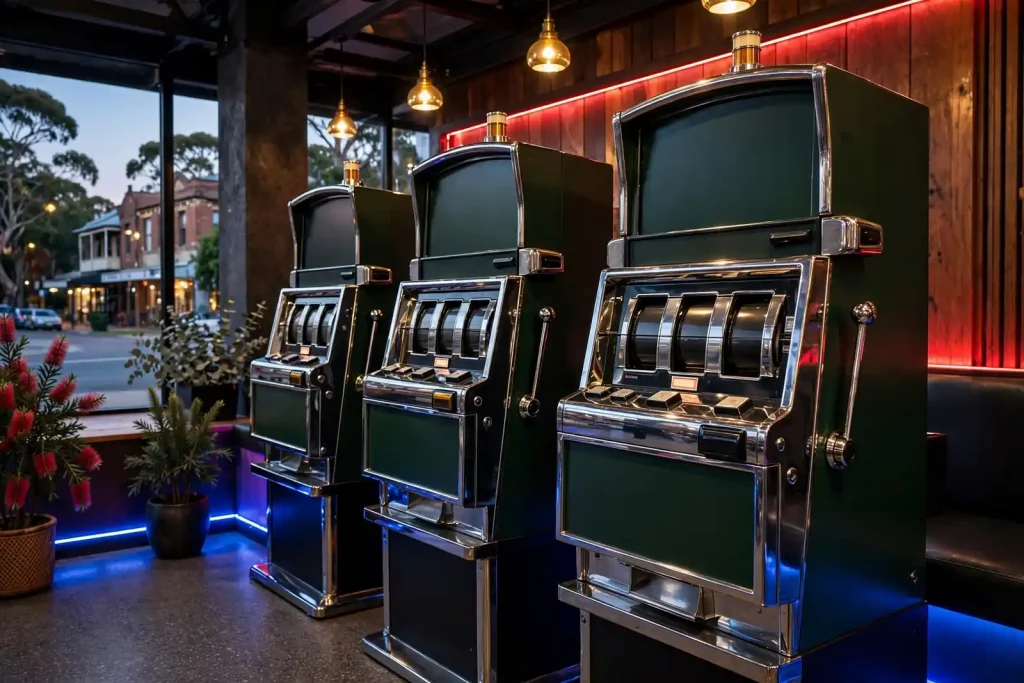
A three-reel game presents a compact picture: three vertical columns of symbols, a spin control and, often, a payline running across the middle. That familiar layout can make the outcome seem as though it comes from watching the reels slow down and stop. In an online pokie, the animation is the display of a result, not the mechanism that decides it.
The underlying mechanism is a Random Number Generator, or RNG. It produces random outcomes, and each spin is a separate event. The result of the previous spin does not make a particular result more or less likely on the next one. A run of misses is not a signal that a win is due; a recent win does not mean the game must now produce a losing result. The next spin has no memory of the last.
That distinction matters because the animation invites people to read meaning into timing. A symbol may appear to pass close to a winning line, or the reels may seem to pause just before a familiar combination. I have seen how easily that near-miss impression becomes part of a player’s explanation for what happened. But the moving symbols are a visual sequence. They do not establish that the game was about to award a different result.
Choosing reel slots in Australia for 2026 starts with checking the details that matter to you before you play. Use this list as a quick reference when considering the operators’ available licensing and payment information.
1. Golden Pokies
License: Curacao Golden Pokies lists a Curaçao licence. This gives you a licensing detail to consider when assessing the operator.
2. Playfina Casino
License: Curacao eGaming (Hollycorn N.V., since 2017) · Min. deposit: A$20-30 (depends on the offer) Playfina Casino lists a Curaçao eGaming licence held by Hollycorn N.V. since 2017. The minimum deposit is A$20–30, depending on the offer.
3. LuckyVibe
License: Curacao Gaming Control Board OGL/2023/176/0095 (Hollycorn N.V.) LuckyVibe lists Curaçao Gaming Control Board licence OGL/2023/176/0095, held by Hollycorn N.V. Its stated licence information is a key detail for your checks.
4. SkyCrown
License: Tobique Gaming Commission · Payout speed: crypto ~10-15 minutes, fiat 1-5 days · Min. deposit: A$30 SkyCrown lists a Tobique Gaming Commission licence and a minimum deposit of A$30. Its stated payout times are around 10–15 minutes for crypto and 1–5 days for fiat.
5. JeetCity Casino
License: Curacao eGaming (Dama N.V.) JeetCity Casino lists a Curaçao eGaming licence held by Dama N.V. This provides a specific licensing detail to consider.
6. Lucky Dreams
License: Curacao · Min. deposit: A$20 (POLi) Lucky Dreams lists a Curaçao licence and a minimum deposit of A$20 via POLi. The deposit detail may be useful when checking whether its payment options suit you.
7. House of Pokies
License: international iGaming licence – jurisdiction not named in the source · Payout speed: PayID 1-24 hours · Min. deposit: A$30 (PayID from A$10) House of Pokies lists an international iGaming licence, though the jurisdiction is not named in the source. PayID withdrawals are stated as taking 1–24 hours, and the minimum deposit is A$30, or A$10 when using PayID.
8. Vegaz Casino
License: Curacao OGL/2024/1335/0780 · Min. deposit: EUR 20 Vegaz Casino lists Curaçao licence OGL/2024/1335/0780. Its stated minimum deposit is EUR 20.
9. Thor Casino
License: Curacao – Antillephone N.V. (Versus Odds B.V.) · Min. deposit: EUR 20 Thor Casino lists a Curaçao licence from Antillephone N.V. for Versus Odds B.V. Its stated minimum deposit is EUR 20.
10. Wild Tokyo
License: Curacao · Payout speed: crypto 30-60 minutes, fiat 1-5 days · Min. deposit: A$10 Wild Tokyo lists a Curaçao licence and a minimum deposit of A$10. Stated payout times are 30–60 minutes for crypto and 1–5 days for fiat.
The result and the display
A useful way to understand a 3-reel slot machine is to separate its outcome from the way the screen presents it. The RNG supplies the random basis for a spin. The game then shows a corresponding arrangement of symbols on the reels. Those symbols are interpreted according to the game’s rules: a displayed combination may pay, trigger a feature, or do neither.
The exact rules vary from one game to another. A classic three-reel layout may look simpler than a larger game, but the number of visible reels does not make outcomes predictable. Nor does a plain screen mean that the game is operating by a different principle. The visual format is not a guide to what the RNG will produce.
In a physical machine, the reels moving in front of a player are part of the equipment. Online, the reels are rendered on a screen. That difference can make the digital version feel more like a sequence of symbols being dealt out in real time. It is still important not to confuse the screen’s movement with evidence about the next outcome. The spin is resolved as an independent random event; the animation gives that event a visible form.
Why previous spins do not form a pattern
People naturally look for patterns. If the same symbol appears several times, it is tempting to infer that the game is warming up. If a particular combination has not appeared for a while, it can feel overdue. Those impressions are understandable, but they do not change the independence of spins.
5-Reel Slots in Australia: Features and Play
The RNG does not keep a running account of what a player has just seen and then compensate for it on the next turn. Each spin stands on its own. A long sequence can contain repetition, streaks or abrupt changes without those features proving that the next result is due to follow a pattern. Random sequences do not always look evenly mixed in short stretches.
This is one reason a 3-reel classic slot can feel deceptively readable. The limited number of reels and the repeated symbols make the screen easy to scan. A player can quickly recognise familiar arrangements and remember striking results. But ease of recognition is not control over the outcome. The format may be visually straightforward while remaining random at the point of each spin.
A near miss is particularly persuasive because it resembles a win. Two matching symbols and a third just above or below the payline can look like a result that almost happened. That is a description of the displayed arrangement, not proof that the game moved toward a win or that another spin is more likely to complete the pattern. The next event remains independent.
What the layout can and cannot tell you
The reels tell a player how the game represents outcomes. The rules explain which displayed combinations count and what features may be available. Neither the reel count nor the animation reveals what the next spin will show. Online pokies also have theoretical RTP percentages, but those figures describe a separate statistical feature of the game rather than a forecast for an individual spin.
Attention: The visual movement of symbols and near-misses are animations that do not indicate the game is closer to a win or that a pattern is forming.
I keep these ideas apart because they answer different questions. The RNG explains how outcomes are generated; the reels show an outcome; the rules explain how the symbols are evaluated. Treating those as one process encourages faulty conclusions, especially when a screen appears to “almost” land on something.
A three-reel game is therefore not a sequence that can be decoded by tracking recent symbols. Its familiar presentation can make it look mechanical in the everyday sense, as though watching closely might reveal a rhythm. Underneath, each spin is an independent random event. The display may be simple. The outcome is not readable from the last one.
Sweet Bonanza: RTP, Scatters and Free Spins
Sweet Bonanza is often discussed alongside bonus-focused pokies, but its return figure and free-spin feature are separate parts of the game. The RTP describes a theoretical return across extensive play; it does not tell anyone what a particular session will produce. The bonus, meanwhile, is triggered by scatters and can include multiplier bombs. Those details are worth keeping distinct: a feature can change how a winning tumble is calculated without changing the meaning of the published RTP.
A specialist review reports an RTP of 96.51% for Sweet Bonanza, while noting that other versions can show a different figure. That qualification matters. The game name alone does not establish which return configuration is in use, and a figure quoted in a review should not be treated as confirmation of the build offered in any particular setting. The in-game information is the relevant place to identify the configuration.
7-Reel Slots in Australia: How to Assess the Claims
I have seen how a single percentage can become the headline while the conditions around it fade into the background. Here, the careful reading is not “this version always pays 96.51%”; it is that a specialist review reports that figure for a version, and other versions may differ. A decimal point gives a number a precise appearance. It does not make it universal.
The free-spin feature is triggered by scatter symbols. A specialist review describes four or more scatters as awarding 10 free spins. That is a report of the feature’s rules, not a promise that scatters will land within any given number of spins. Nor does the award itself establish a particular result: free spins provide additional rounds under the feature, while the outcome of each round remains uncertain.
That distinction is easy to lose in promotional language. “Bonus” sounds like a result; mechanically, it names a feature. Scatters can activate the free-spin round, but the word does not mean that a winning amount is guaranteed. The award and what happens during those spins are different events.
Multiplier bombs are another part of the feature. A specialist review reports that bombs can appear during free spins and that their values are added together before being applied to a winning tumble. In practical terms, the total of the multipliers is used with a qualifying tumble’s win; the multiplier is not a separate prize simply because it appears. The reported sequence is important: the values are combined first, then applied to the winning tumble.
Multiplier bomb values are added together first, and the total is then applied to a qualifying winning tumble during free spins.
That sequence also explains why a multiplier value cannot be read in isolation. Its effect depends on there being a winning tumble to which it can be applied. A large-looking number on screen is not, by itself, a statement about the final result. The underlying win matters. The display can make the feature feel dramatic; the calculation remains conditional.
A tumble is the game’s term for a winning group of symbols that is cleared and followed by another arrangement. The multiplier detail described by the specialist review relates to a winning tumble during free spins. It should not be expanded into a claim that every spin produces a tumble, that every bonus round contains bombs, or that a particular multiplier will appear. Those would go beyond the reported mechanics.
The same caution applies when comparing descriptions of Sweet Bonanza with classic three-reel pokies. The name of a bonus feature does not make the game a classic three-reel format, and the scattered symbols and multiplier bombs are specific to the feature described here. Search phrasing that groups bonus games with three-reel games does not alter a game’s mechanics. Format and bonus design are separate questions.
In Australia, this description is informational, not an invitation to play. The Interactive Gambling Act 2001 prohibits operators from providing real-money online casino games, including pokies, to people in Australia. Describing a game’s reported RTP or bonus mechanics does not make it available through a locally licensed online casino.
The useful distinction is simple: the RTP figure is version-dependent, scatters are reported to award free spins, and multiplier-bomb values are reported to combine before affecting a winning tumble. None of those details predicts the next outcome. No guaranteed bonus.
Video Slots in Australia: Mechanics, RTP and Access
Reading RTP Without Treating It as a Promise
RTP is a long-run measure, not a session forecast. The percentage describes a slot’s theoretical return across a vast volume of play, often millions of spins. It is useful for comparing games on that basis, but it does not describe what a particular player will receive during a short visit. That distinction matters just as much with a three-reel pokie as with any other format.
I have seen RTP treated as if it were a repayment schedule: the higher the displayed figure, the more certain the result is supposed to feel. That reading gives the statistic a job it cannot do. RTP does not map out the next run of spins, set a minimum return for a session or show when a game will pay. It describes an expectation across a very large sample. Individual results can sit far from that expectation.
What the percentage can tell
A higher RTP is theoretically more favourable to players over time than a lower one. That makes it a useful point of comparison when assessing three-reel games. It does not, by itself, establish that a game is enjoyable, easy to understand or suitable for a particular style of play. It answers a narrower question: what return does the game’s mathematical model project over extensive play?
For that reason, the figure is best read as a comparative measure, not a promise. Two games can show different RTP values, and the higher figure indicates the more favourable theoretical return over the long run. It does not follow that the higher-RTP game will produce a better result in any individual session. Nor does a lower result in one session prove that the stated RTP is wrong. The measure and the immediate outcome operate on different scales.
Do
- Use RTP as a comparative measure between games
- Treat RTP as a long-run theoretical average
Don’t
- Treat RTP as a guaranteed session forecast
- Use RTP to predict when a game is due to pay
I avoid translating RTP into a prediction about a player’s balance. The percentage is not a timetable, and it does not say how outcomes will be distributed over a particular stretch of play. A concise statistic can look more precise than the experience it describes. That is the catch.
Comparing three-reel games
The three-reel format is a visual and structural description, not an RTP category. A traditional-looking layout does not automatically imply a higher or lower return. The figure must be considered game by game rather than inferred from the number of reels, familiar symbols or a classic presentation.
When comparing three-reel slots, RTP can help separate theoretical return from appearance. A simple layout may feel more transparent, but visual simplicity does not establish its mathematical return. Equally, a more elaborate presentation does not prove that its RTP is less favourable. The percentage is the relevant comparison for theoretical return; the design is a separate matter.
A useful benchmark is an RTP of 96% or higher. That is a screening point, not a guarantee of value in every other sense. It does not turn a game into a safe choice, remove uncertainty from a session or ensure that a short run will resemble the long-run calculation. I would not treat a game below that benchmark as automatically defective, either; the number is a way to compare theoretical returns, not a complete judgement of quality.
The label “best” can conceal several different standards. One person may mean the strongest theoretical return, while another may be thinking about theme or pace. RTP can support the first comparison, but it cannot settle the broader question by itself. A three-reel pokie with a higher figure is theoretically more favourable on return over time; that is all the statistic warrants.
Low Volatility Slots in Australia: How They Work
Keep the timescale in view
The practical mistake is to move from a large-scale calculation to a small-scale expectation. RTP belongs to the former. A session belongs to the latter. The two should not be confused, even when a percentage is displayed prominently or described in confident language.
I use RTP as one piece of information, with a clear boundary around what it means. It helps compare theoretical returns across games and gives a reason to favour a higher figure when that is the criterion. It does not forecast a personal result, make outcomes due or convert a short session into evidence about long-run performance. That boundary is the point.
Classic Three-Reel Slots and Their Paytables
A classic three-reel slot machine is defined by its compact visual language: a small set of reels, familiar symbols and a paytable that explains which symbol combinations count as wins. The screen may resemble an older mechanical machine, but that appearance does not tell the whole story. Online pokies are software, and the rules shown in the game are the useful reference point—not the artwork or the word “classic” in a title.
I have found it helpful to treat the paytable as the game’s operating manual rather than a decorative panel. It sets out which combinations are recognised, how the game assigns value to them and what other rules affect a result. A symbol that looks prominent on the reels is not automatically the most valuable one. The table is where the game explains its own hierarchy.
The paytable serves as the game’s operating manual, defining which symbol combinations count as wins and how values are assigned.
The layout can be spare, but the details still matter. A paytable may use symbol images and diagrams to show where combinations must land. It can also explain how special symbols behave, if the game has them. The rules determine whether a displayed arrangement qualifies; visual similarity alone is not enough. That is a small distinction, but it is where assumptions about a classic format often go wrong.
The RTP is usually displayed in the game’s rules or paytable. In practice, that means looking inside the game interface rather than relying on a short description beside its title. The lobby tile is a label, not the full rules panel. In a classic design, the relevant information may sit alongside symbol values or in a separate rules tab. The placement varies, so the task is to locate the stated RTP and read the surrounding game information as part of the same check.
The word “classic” can create an impression of simplicity. It describes a style, not a guarantee that the rules are identical between games. Two three-reel titles can use different symbols, combination requirements and payout structures. A familiar fruit symbol or a traditional-looking layout does not establish how a particular game works. The paytable does.
For classic three-reel slots online, that distinction is especially easy to miss because the interface may imitate a physical cabinet. The animation can make a result feel like a mechanical stop, while the displayed rules remain the actual explanation of how combinations are evaluated. I would not infer the game’s return or its full conditions from the speed of the reels, the sound effects or the design. Those are presentation choices.
High-Volatility Slots in Australia: How Payouts Work
Free-play versions can also present the same style of interface, but the label alone does not explain the game’s rules. The practical point here is narrow: a classic appearance is not a substitute for the information panel. Whether a game is being viewed in a free-play mode or another format, the paytable is the place that describes its combinations and, where displayed, its RTP.
There is no special RTP category called “classic.” The format tells something about the arrangement and presentation of the reels; the rules panel provides the game-specific information. Keeping those two ideas separate avoids reading an old-fashioned look as evidence of a particular return or payout pattern.
The panel tells the story.
Real-Money Play and Australian Legal Limits
The legal distinction in Australia is between the person using an offshore service and the operator providing it. Under the Interactive Gambling Act 2001, it is illegal for an operator to offer real-money online casino games, including pokies, to people in Australia. Individuals are not penalised simply for playing at an offshore site. That does not make the service locally authorised or bring it within Australian consumer protections.
Enforcement sits with the Australian Communications and Media Authority (ACMA), the federal body responsible for applying the Act and monitoring compliance with interactive gambling laws. Its role is not limited to identifying prohibited services. ACMA can ask Australian internet service providers to block access to websites that provide prohibited gambling services or advertise them in Australia.
That mechanism operates at the access level. A blocked address may stop loading through an Australian internet connection, but a block is not a ruling on the quality of a game or a guarantee that every related website has been removed. In practice, the target is the service or advertising site identified by ACMA, while changes to domains and online infrastructure can make enforcement an ongoing task.
Legal Warning
Under the Interactive Gambling Act 2001, it is illegal for operators to provide real-money online casino games, including pokies, to people in Australia.
The scale of ACMA’s activity is substantial. Following enforcement actions, it has blocked more than 1,455 illegal gambling and affiliate websites since November 2019. The figure covers both gambling services and affiliate sites; it should not be read as a count of casino operators alone. Blocking is one part of the response, alongside monitoring compliance and pursuing action under federal law.
The number of services said to have withdrawn from Australia since enforcement began in 2017 is reported inconsistently. One figure is more than 210; another is over 190. Those totals should not be silently combined or treated as identical. They indicate reported withdrawals over the period, but the disagreement means the precise total depends on which account is being cited.
From inside the industry, a website block is best understood as a practical enforcement measure rather than a change to the underlying rule. The law already prohibits operators from supplying these services to Australian residents. ACMA’s blocking requests make that prohibition more visible in day-to-day access, while the figures on blocked sites show that enforcement has been sustained rather than a one-off exercise.
This also explains why “real-money” availability and legal status are separate questions. A website may be reachable at one moment and unavailable later; reachability does not establish that an operator is permitted to serve Australians. Equally, an access block does not change the fact that the statutory restriction is directed at providers. The distinction matters in a market where offshore services can appear in search results despite operating outside Australia’s consumer-protection system.
Progressive Jackpot Slots: How Their Prize Pools Work
The enforcement picture is therefore defined by three elements: a federal law restricting online casino services, an authority monitoring compliance, and blocking requests directed to Australian internet providers. The scale figures provide context, but not a complete map of every service or every enforcement outcome. Access can change. The legal boundary remains.
Free Play, Stakes and the Game Configuration
A game’s lobby tile is a label, not a technical specification. In particular, it does not show which RTP build has been assigned to that version of the game. A specialist review describes the operator as selecting the build, so the same title may not carry the same configuration wherever it appears. The detail to inspect is inside the game: open its information panel and look for the stated RTP.
That check matters even when the title and artwork look familiar. A free-play screen may show how a game is arranged, but the lobby image cannot confirm the configuration attached to a real-money version. Nor does the game’s name, by itself, establish its return setting. The information panel is the relevant place to verify the displayed figure; promotional labels and thumbnail graphics do not substitute for it.
For Sweet Bonanza, a specialist review reports a stake range of A$0.20 to A$100 per spin. The upper end varies by operator, so that range should not be read as a limit applying everywhere. The available stake controls are a separate detail from RTP: changing the stake does not identify which RTP build is running, and a displayed stake range does not confirm the game’s configuration.
Verify Game Configuration
- Open the in-game information panel
- Locate the stated RTP for the specific build
- Check the available stake range for the operator
Free play and real-money play can therefore answer different practical questions. A demonstration mode may provide a way to view the interface and its settings, while the actual game information panel is where the configured RTP is stated. Treating a free-play display as proof of the real-money build would confuse the presentation of the game with the operator’s configuration.
For a three-reel slot game, the same distinction applies: the number of reels and the lobby artwork describe the format, not the RTP build. Before depositing, verify the game’s configured RTP in its in-game information panel. In Australia, that check does not change the legal status of real-money online pokies: operators are prohibited from offering them to Australian residents. The information is a configuration detail, not permission to play.
Playing in a Browser: What “No Download” Means
“No download” describes how a game is delivered, not whether it is legal or available in Australia. A browser-based game runs through a web page rather than requiring a separate game client to be installed. A downloadable version, where offered, uses software saved to a device. Neither label changes the rules governing online pokies.
The Interactive Gambling Act 2001 prohibits Australian-licensed operators from offering pokies online. That means a browser window is not a legal workaround, and installing software does not change the service being provided. The distinction is technical, not regulatory.
The practical picture is also shaped by enforcement. The Australian Communications and Media Authority (ACMA) enforces federal interactive gambling laws and can ask internet service providers to block websites offering prohibited gambling services or advertising them in Australia. It reports that more than 1,455 illegal gambling and affiliate websites have been blocked since November 2019 following enforcement action. A blocked page may therefore be inaccessible through an Australian connection; changing from a browser to an installed app does not make the underlying offer lawful.
‘Best-paying’ online pokies in Australia: what claims mean
A specialist review also notes that offshore operators sit outside Australian consumer protection. That matters because the appearance of a familiar game, or a page that loads cleanly, does not establish that the service is locally regulated. Access is not endorsement. Nor is a working link proof that it will remain reachable.
In practice, “free download” and “no download” can sound like competing conveniences. They describe different routes to the same kind of online service. For Australian readers, the central issue is not which route installs more easily, but whether the service itself is permitted. Under the local framework, online pokies from Australian-licensed operators are prohibited, while ACMA’s blocking activity targets prohibited offshore services and their promotion.
The label is small. The legal distinction is not.
Free Play and the Boundary Between Practice and Real Money
“Free play” describes a mode in which a game can be tried without staking real money. That is a different arrangement from real-money play, where a stake is placed and the outcome can affect a cash balance. The screen may look similar in both modes; the important distinction is whether money is being wagered, not whether the reels or symbols are familiar.
The difference matters in Australia because the legal boundary is set by the service being offered. Under the Interactive Gambling Act 2001, Australian-licensed operators cannot offer online pokies or table games. A practice mode does not turn a prohibited real-money service into a permitted one, and a free-play label alone does not establish what kind of service is being provided. The surrounding arrangement matters.
Attention: A free-play or demo mode does not establish that a real-money version of the game is lawfully offered by an Australian-licensed operator.
Age is a separate condition. Players must be at least 18 to play. That threshold should not be confused with the question of whether a game is offered for practice or for money: age eligibility and the operator’s legal position are distinct issues.
I have seen how interface labels can make these categories look interchangeable. “Demo” sounds like a simple preview, while “play” can describe either a no-stake session or a wager. The label is not the whole story. What matters is whether the session uses real money and who is providing the service.
For three-reel games, free play can be understood as a way to see the format without placing a stake, where such a mode is available. It should not be read as proof that the same game can lawfully be offered for real-money play by an Australian-licensed operator. Nor does a practice setting change the statutory restriction on online pokies and table games.
Best Pokie Machines to Play in Australia: A Guide
The practical boundary is therefore narrow but clear: practice and wagering are not the same activity, yet the Australian rule on licensed online services still applies. Age remains relevant in either context. Labels can blur the distinction. The service decides.
Online Availability, Offshore Access and Payment Caveats
Sweet Bonanza reaches Australian players through casinos licensed overseas; it is not offered by a locally licensed online casino. That distinction matters. The Interactive Gambling Act 2001 puts the prohibition on the operator: a business cannot provide online pokies to people in Australia. The individual player is not penalised simply for accessing an offshore site, but that does not make the service locally authorised or bring it within Australian consumer protections.
Offshore access is also not the same as stable access. The Australian Communications and Media Authority can ask internet providers to block websites carrying prohibited gambling services, and it actively uses that power. A site that loads today may later become inaccessible. The practical position is therefore different from a regulated domestic service, where the market and consumer safeguards are established locally.
New Australian Online Pokies: Legality and Claims
Payments need separate scrutiny. A specialist review of offshore operators reported that several it tested accepted PayID. That is a limited observation, not a guarantee that a particular casino still supports the method or that a transaction will work in every case. Payment options can change with the operator, and acceptance of a familiar Australian payment method does not establish that the casino is licensed in Australia, safe, or endorsed by any authority.
The same separation applies to “available” and “approved”. A title appearing on an offshore casino’s site shows only that the operator makes it accessible there; it does not change the legal position for the business or the protections available to a customer. I have seen payment branding do a lot of quiet work in a checkout flow. Familiar does not mean local.
Three Reels, Three Symbols: What the Search Term Can Mean
“Three-reel slots” describes a format: the game presents three reels. It does not name a separate family from “3-reel slots”; the numeral and the word are simply two ways of expressing the same count.
Pokies Tips and Tricks: Practical Advice for Australia
The comparison implied by “three reels versus three reels” has no meaningful contrast on its own. Both sides describe the same reel count. A real distinction would need another feature to compare, such as the number of reels, the layout, or how symbols are arranged. Without that, the wording repeats itself rather than identifying two categories.
Reels and symbols are related, but they are not interchangeable terms. Reels are the visible columns that turn. Symbols are the images shown on them: fruit, cards, or other icons, depending on the game. A three-reel game can contain more than three symbol types, so the number of reels does not tell the full story of its visual design.
From behind the counter, I saw this confusion arise because labels are often shortened until the important distinction disappears. “Three reels” tells the format. It does not, by itself, describe the symbol set or establish a competing format. Same count. Different words.
Are three-reel pokies legal for Australian players in 2026?
Australian-licensed operators cannot offer online pokies under the Interactive Gambling Act 2001. Individuals are not penalised for playing at offshore sites, but those operators are outside Australian consumer protection and the ACMA can block access to prohibited services.
How is the RTP of slots calculated?
RTP is a theoretical statistical return calculated over a very large number of spins, often millions. It describes expected performance over time, not the result of an individual spin.
How do you calculate RTP in slots?
RTP reflects a slot’s theoretical return across a vast number of spins, often millions. It is usually listed in the game’s rules or paytable.
Why is understanding slot RTP important for players?
RTP helps players compare a game’s theoretical return over time with that of other slots. A higher RTP theoretically offers a better return over time, though it does not predict individual results.
Do higher RTP slots guarantee bigger wins?
No. A higher RTP indicates a better theoretical return over time, not a guaranteed win or larger payout on any particular spin.
Casino Games

Aristocrat Online Pokies in Australia: What to Know
The name alone does not identify a machine, its provider or where it can be...

5-Reel Slots in Australia: Features and Play
Learn how bonus triggers, RTP figures, free-play mode and game versions shape what a five-reel...

7-Reel Slots in Australia: How to Assess the Claims
A practical guide to seven-reel claims, RTP settings, demo play and Australian access without treating...

Bonus Buy Slots in Australia: How the Feature Works
A bought feature moves the decision to the start of a spin, but its outcome...

High-Volatility Slots in Australia: How Payouts Work
High volatility means substantial wins tend to be less frequent; it does not make a...

Low Volatility Slots in Australia: How They Work
Low volatility describes a pattern of more frequent, smaller returns, not a forecast for any...

New Australian Online Pokies: Legality and Claims
A practical look at Australian restrictions, game-release claims, verification, Bitcoin transactions and the terms that...

‘Best-paying’ online pokies in Australia: what claims mean
Bitcoin describes a payment method, while game returns, bonus rules and real-money stakes are separate...

Best Pokie Machines to Play in Australia: A Guide
Explore game formats, odds and RTP alongside the legal distinction between operators offering online pokies...

Progressive Jackpot Slots: How Their Prize Pools Work
A practical look at how contributions, qualifying bets, game features and bonus terms shape progressive...

Best RTP Slots in Australia: How to Compare
RTP depends on a slot’s configuration and describes long-term returns, while variance affects how results...

Video Slots in Australia: Mechanics, RTP and Access
A practical guide to slot mechanics, device layouts, RTP, volatility and the limits that shape...

Bitcoin Pokies in Australia: Payments and Legal Context
Bitcoin is a payment method, not a different game, and displayed credits do not automatically...

Casino Dice Games in Australia: Rules and Risks
From craps to other dice-based casino games, this guide explains what their rules and online...

Crash Casino Games in Australia: Access and Payments
A practical guide to crash-game mechanics, operator restrictions, payment trade-offs, verification and the limits of...

Dragon Link Online Pokies in Australia: What to Know
A practical look at digital Dragon Link play, free-play limits, Bitcoin transactions and the legal...

Lightning Link online pokies in Australia: legal limits
The guide explains free-play credits, Hold and Spin, linked jackpots, mobile access and the legal...

Live Baccarat Online Casinos in Australia: Rules
A practical guide to dealer play, table rules, payments, bonuses and the limits of casino...

Live Blackjack Online Casinos in Australia: Legal Guide
This guide distinguishes advertised live-dealer formats from Australian authorisation and flags what cannot be verified...

Live Roulette in Australia with English-Speaking Dealers
Australia’s rules distinguish offshore roulette offers from locally licensed services, regardless of live video, interface...

Mines Casino Game in Australia: Access and Evidence
A cautious guide to Mines terminology, Australian access, demo searches, bonus conditions and the limits...

Plinko Casino in Australia: Rules, Risks and Payments
A practical look at Plinko and pokie formats, real-money conditions, bonus terms and the limits...

Pokies Tips and Tricks: Practical Advice for Australia
A practical look at game features, random outcomes and the limits of advice on Australian...

Real cash online pokies in Australia: Bitcoin guide
Bitcoin affects how funds are deposited and withdrawn, while game rules, wagering terms, verification and...

Real Money Casino Table Games in Australia
Online tables may use software-generated outcomes or a real dealer stream, while controls and results...

Safe Online Pokies in Australia: What Safety Means
The guide explains what overseas licences establish, where Australian protections stop, and how to assess...