Bonus Buy Slots in Australia: How the Feature Works
 Available in AU
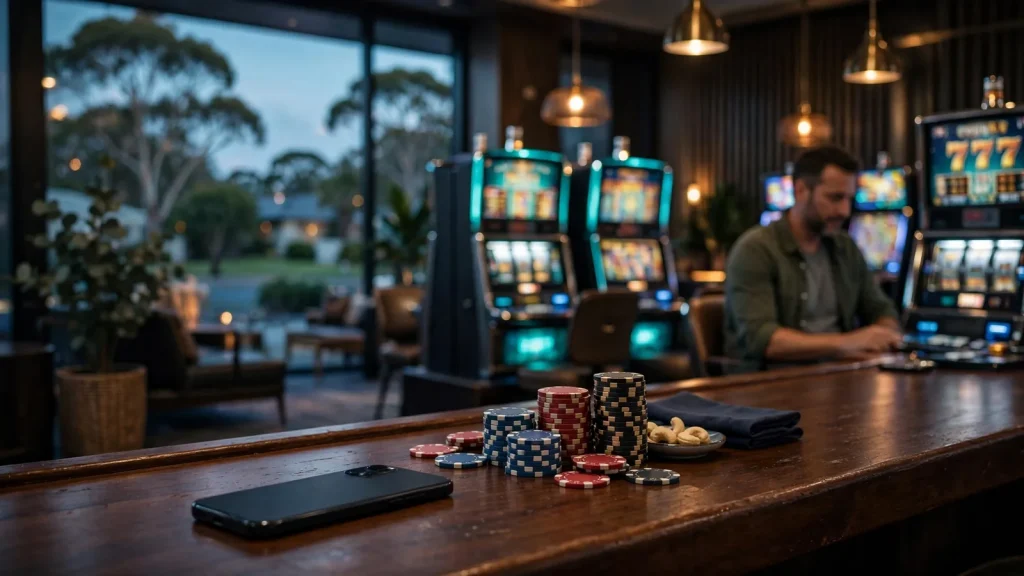
A bought feature moves the decision to the start of a spin, but its outcome remains uncertain and forms part of the session’s cost.
Table of Contents
- How Bonus Buys Change the Casino Slot Session
- Demo Spins, Free Play and What They Can Tell You
- Bonus Buys and the Numbers Behind a Slot
- Where Bonus-Buy Slots Are Available to Australians
- Free Bonus-Buy Play and the Limits of a No-Cost Test
- Online Pokies, Offshore Access and the Australian Rules
- What the Bonus-Buy Feature Actually Does
- Checking a Slot’s Bonus-Buy Configuration Before Wagering
- Sweet Bonanza: A Concrete Bonus-Buy Example
How Bonus Buys Change the Casino Slot Session
A bonus-buy option changes the point at which a slot session begins. In an ordinary session, play starts with the base game and any special feature arrives only if the game’s rules trigger it. With a buy option, the player can pay for access to a feature rather than waiting for that route to occur. The decision moves from the middle of play to the start of a spin.
That changes the shape of the session, not the underlying uncertainty. A bought entry is still part of a random game; it is not a promise that the feature will produce a particular result. The purchase gives access to a different part of the game, while the outcome remains uncertain. I have seen the distinction blurred in promotional language: “instant access” describes when the feature begins, not what it returns.
The practical difference is that the feature price becomes part of the session’s cost before the relevant play starts. A player considering a buy option is making a different commitment from someone placing ordinary base-game spins. It can be easier to underestimate that difference when the button is presented alongside the regular spin controls. The interface makes both actions look like ways to continue; financially, they are not interchangeable.
A different entry point, not a different promise
The option can make a session feel more directed. Instead of allowing the base game to determine whether a feature appears, the player chooses to enter through that feature. That can shorten the route to seeing a particular part of the game, but it does not remove the chance element from the result.
This is where the word “buy” can mislead. It sounds like buying an outcome. In practice, it refers to buying entry into a feature under the game’s stated rules. The distinction matters because access and return are separate things. A session can reach the feature immediately and still produce an outcome that does not meet the player’s expectation.
Australian Pokies & Casino Games Guide
From the operator’s side, the buy option is also a product setting rather than a universal property of every version of a slot. The same game title may not present identical choices in every casino environment. A feature can be available in one configuration and absent in another, or the offered version may differ from what a player has seen elsewhere. A lobby image or title alone does not settle that question.
That is ordinary configuration work: the operator’s game catalogue is assembled from versions and settings made available for its service. A title name can stay constant while the actual build presented to the player changes. In commercial terms, the lobby is a catalogue display, not a complete specification.
What the casino’s configuration changes
For a bonus-buy slot, the relevant distinction is not merely whether the game appears in a lobby. The question is whether the version loaded into play includes the buy feature and what rules govern it. Casino-side configuration can affect which build is offered; a feature’s presence should not be inferred from the game’s name or artwork.
A specialist review reports that the operator selects the game’s RTP build and that this selection is not shown on the lobby tile. The review’s practical point is that the in-game information panel is where the configured version can be checked. That is a useful example of the gap between a catalogue label and the game actually loaded. The buy option itself is not a substitute for checking the information shown inside the game.
I would treat the lobby as an index, not a specification sheet. It helps identify a title, but it may not show the details that distinguish one configuration from another. That difference can matter before any decision about a feature purchase, because the player is interacting with the installed version, not with an abstract title as described elsewhere.
Attention: The presence of a buy button or a game’s title in a lobby does not provide a complete specification of the game’s configuration or its return settings.
The session interface also shapes how the decision is understood. When the buy control is prominent, it can make feature entry seem like the natural next step. When it is absent, the game may still be the same title but offer a different route through play. Presentation is not proof that one route is preferable. It is simply part of how the configured game has been placed in front of the player.
For Australian readers, this discussion is descriptive rather than an invitation to use an offshore gambling service. Online real-money casino games, including pokies, are prohibited services under Australian law when offered to people in Australia. The mechanics of a feature do not change that legal position. A product can be discussed without implying that it is locally available through a lawful Australian online casino.
The useful distinction is simple: a bonus buy changes how a session enters a feature, while the casino’s configuration determines what version and options are presented. Neither the title in a lobby nor the presence of a buy button tells the full story by itself. Interface first. Configuration underneath.
Demo Spins, Free Play and What They Can Tell You
A demo can show how a game presents its rounds without placing a real-money stake at risk. That makes it useful for learning the interface: where the rules sit, how a spin is started and what information appears on screen. It is a much narrower test than it can seem. A run of free spins is not a forecast of what a later session will produce, and it cannot establish that a game is favourable.
Video Slots in Australia: Mechanics, RTP and Access · Pokies Tips and Tricks: Practical Advice for Australia
That distinction matters when a demo includes a bonus-buy option. The option may let a player enter a feature without first waiting for it to appear through ordinary play. But seeing that route in a demo tells little about the results of a real-money session. It shows a possible way into a game state, not a reliable outcome from it.
I separate two kinds of learning. One is interface familiarity: identifying the controls and reading the game’s rules. The other is evidence about likely returns. A demo can help with the first. A short sequence of randomly generated outcomes cannot provide the second.
What a demo run actually shows
Each spin is generated independently by a Random Number Generator (RNG). The result of one spin does not make a particular result more or less likely on the next one. A string of losses does not mean a win is due; a strong result does not make another one more likely either. The sequence has no memory.
This is easy to accept as a principle and harder to feel while watching a session unfold. In a demo, the immediate feedback is vivid: a result appears, the balance changes, and the next spin follows. The visible sequence can invite a story about momentum or a pattern. That story is not evidence that the game has changed its behaviour. It is the mind giving meaning to independent events.
A few demo spins can still answer practical questions about presentation. They can reveal whether the rules are readable, whether the interface makes the stake and feature controls clear, and whether the bonus-buy option is visible in that version. Those are observations about the interface. They do not show what the next spin will do, nor do they establish how a longer session will perform.
A demo is best used as a presentation test to familiarise oneself with the interface and rules, rather than as a tool to predict future real-money results.
A demo can also differ from the real-money version in ways that matter to interpretation. The available controls or displayed information may not match across every version or setting. The presence of a feature in free play is therefore not proof that the same configuration is available elsewhere. What appears on screen is evidence about that session, not a guarantee about another one.
The limit of a short sample
RTP is a theoretical statistical calculation. It describes expected performance over a vast number of spins, often millions, rather than promising a particular return in a brief session. A demo run is only a tiny slice of possible outcomes. Even if its results look unusually generous or unusually poor, that does not overturn the statistical meaning of RTP.
This is where demo play can mislead without being inaccurate. The spins shown are real game outcomes within the demo environment, but a small sample is not representative simply because it is easy to observe. A player may see several outcomes that feel consistent with a belief about the slot, then mistake that impression for a dependable pattern. The sample remains too limited to support that conclusion.
There is a second trap: treating a demo balance as though it were a measure of practical affordability or risk. Free-play credits are not a personal budget and do not reproduce the emotional weight of spending real money. The interface may look similar, but the consequences of a result are not. That difference can affect how long someone keeps playing, how freely they test controls, and how they interpret a win or loss.
3-Reel Slots in Australia: How the Games Work · New Australian Online Pokies: Legality and Claims
For that reason, a demo is best understood as a presentation test. It can make the rules and screen flow more familiar. It cannot test how someone will respond when each result affects a real balance, and it cannot convert random outcomes into a prediction.
Bonus-buy demonstrations need careful reading
The phrase “instant feature” sounds decisive. In practice, it describes an entry route, not a promise about what follows. A demo that exposes a bonus-buy control can show how the game labels or presents that choice. It does not show that using it will produce a particular result, or that one trial says anything dependable about another.
There is also a distinction between seeing a control and establishing what is available in a specific game version. A free-play environment may display one set of options, while another setting may present them differently. A demo therefore needs to be read on its own terms: it shows the configuration loaded in that environment, not every possible configuration of the game.
I have found that the most useful demo observations are modest and concrete. Is the information easy to locate? Does the screen make clear which action is being taken? Can the rules be read before play continues? These questions concern comprehension, not value. They avoid turning a short run into a claim about how often a feature will pay or whether it is worth entering.
Do
- Use demos to locate rules
- Check if the interface is clear
- Verify if bonus-buy is visible
Don’t
- Predict returns from a demo
- Assume a streak is a pattern
- Treat free credits as a budget
That is the boundary. A demo can reduce uncertainty about the interface while leaving uncertainty about outcomes exactly where it was.
Reading the rules, not the run
RTP is usually listed in a game’s rules or paytable. Looking there is more informative than trying to infer a percentage from a handful of demo results. The displayed figure is a theoretical measure, not a session promise, and it should not be confused with what happened during one free-play run.
Even a long personal test cannot reproduce the vast number of spins behind a theoretical calculation. Repeating demo sessions may create more examples to watch, but it does not make the next result predictable. Nor does a memorable streak tell whether the underlying game has changed. Randomness can produce clusters and swings without following a pattern that a player can exploit.
This is why “testing” needs a precise meaning. Testing whether the controls are understandable is a reasonable use of free play. Testing whether a slot will return a certain amount is not. The former can be observed directly; the latter cannot be established by a brief run of random outcomes.
When people look for a bonus-buy slot demo, they may be trying to understand the experience before making a decision. The honest answer is that free play can clarify what the interface shows and how the rules are organised. It cannot validate expectations about results, establish a winning sequence, or make random spins less random.
5-Reel Slots in Australia: Features and Play
Useful for orientation. Not for prediction.
Bonus Buys and the Numbers Behind a Slot
A percentage beside a bonus-buy slot can look like a direct answer to the question of what it will pay. It is not. RTP, or return to player, is a theoretical measure of a game’s performance across a very large body of spins. It gives a way to compare the mathematical return built into different games over time, not a forecast for an individual session.
I read the percentage as a long-run comparison, not as a promise attached to a particular stake or feature. A higher RTP indicates a theoretically better return over time than a lower RTP. That distinction matters when comparing games with a bonus-buy option: the feature label describes an available way into play, while RTP describes the game’s theoretical return across its play. One does not make the other a guarantee.
The figure is expressed as a percentage, so it can be tempting to treat it like a fixed share returned from every wager. That is the wrong reading. RTP is calculated over an enormous number of spins, often millions. A short run can differ sharply from the theoretical figure because each spin is generated randomly and is independent of the spins around it. The number is meaningful at scale. On a single session, it does not dictate an outcome.
Attention: RTP is a long-run theoretical measure calculated over millions of spins and does not guarantee a specific return for an individual session.
This is why two figures that appear close should not be turned into a claim about which game will pay more during a particular visit. The higher number has the stronger theoretical return when considered over time; it does not establish what happens next. A dramatic result in a short run does not prove a game has a better RTP, either. Short-run outcomes and long-run calculations answer different questions.
A useful comparison begins with the displayed RTP, but the percentage needs context. It should be treated as one measure of a slot’s mathematical profile, rather than a rating of how entertaining, volatile or suitable it will feel. Those are separate qualities, and the RTP alone does not describe them. For bonus-buy slots, the same caution applies: paying for access to a feature does not alter what the RTP percentage means.
The practical threshold often used when screening slots is 96% or higher. That gives a consistent starting point for comparing stated RTP figures. It is not a dividing line between a game that pays and one that does not, nor does it promise a favourable result. A slot below that level has a lower theoretical return than one above it, all else being equal; a slot above it still produces random outcomes.
I would also avoid treating the number as a personal return estimate. If an RTP is displayed as a percentage, it does not mean that percentage of a player’s own spending will come back during a session. The calculation concerns expected performance over a vast number of spins, not an individual’s account balance. That is the part advertising summaries tend to flatten.
The percentage is useful precisely because it can compare like with like at a broad mathematical level. It becomes misleading when presented as a prediction, an assurance or a ranking of likely short-term results. In assessing bonus-buy slots, the number can narrow a comparison, but it cannot settle the decision by itself. The distinction is plain. Long-run measure, not a promise.
Where Bonus-Buy Slots Are Available to Australians
Bonus buy slots let you access a feature directly, but terms and availability can vary by casino and game. Use this list as a starting point and check the relevant bonus and payment conditions before playing.
1. Golden Pokies
License: Curacao Golden Pokies is listed with a Curacao licence. The provided information does not include bonus buy or payment details.
2. Playfina Casino
License: Curacao eGaming (Hollycorn N.V., since 2017) · Min. deposit: A$20-30 (depends on the offer) Playfina Casino holds a Curacao eGaming licence through Hollycorn N.V., which has been licensed since 2017. Its minimum deposit is A$20–30, depending on the offer.
3. LuckyVibe
License: Curacao Gaming Control Board OGL/2023/176/0095 (Hollycorn N.V.) LuckyVibe is licensed by the Curacao Gaming Control Board under OGL/2023/176/0095, with Hollycorn N.V. named as the operator. No bonus buy or payment details are provided.
4. SkyCrown
License: Tobique Gaming Commission · Payout speed: crypto ~10-15 minutes, fiat 1-5 days · Min. deposit: A$30 SkyCrown is licensed by the Tobique Gaming Commission and has a stated minimum deposit of A$30. Crypto payouts are listed at around 10–15 minutes, while fiat payouts take 1–5 days.
5. JeetCity Casino
License: Curacao eGaming (Dama N.V.) JeetCity Casino holds a Curacao eGaming licence through Dama N.V. The provided details do not specify bonus buy or payment features.
6. Lucky Dreams
License: Curacao · Min. deposit: A$20 (POLi) Lucky Dreams is listed with a Curacao licence and a A$20 minimum deposit via POLi. The supplied information does not detail its bonus buy offering.
7. House of Pokies
License: international iGaming licence – jurisdiction not named in the source · Payout speed: PayID 1-24 hours · Min. deposit: A$30 (PayID from A$10) House of Pokies has an international iGaming licence, though the jurisdiction is not named in the source. PayID payouts are listed at 1–24 hours, and the minimum deposit is A$30, or A$10 via PayID.
8. Vegaz Casino
License: Curacao OGL/2024/1335/0780 · Min. deposit: EUR 20 Vegaz Casino is listed under Curacao licence OGL/2024/1335/0780. Its stated minimum deposit is EUR 20.
9. Thor Casino
License: Curacao – Antillephone N.V. (Versus Odds B.V.) · Min. deposit: EUR 20 Thor Casino is licensed in Curacao by Antillephone N.V., with Versus Odds B.V. named in the details. Its minimum deposit is EUR 20.
10. Wild Tokyo
License: Curacao · Payout speed: crypto 30-60 minutes, fiat 1-5 days · Min. deposit: A$10 Wild Tokyo is listed with a Curacao licence and a A$10 minimum deposit. Crypto payouts are listed at 30–60 minutes, while fiat payouts take 1–5 days.
The phrase “available to Australians” can mean two different things: a game may be technically accessible through an offshore website, while the service offering it is still prohibited under Australian law. That distinction matters for bonus-buy pokies just as it does for other online casino games. A feature appearing in a game does not make the site offering it locally authorised.
The Interactive Gambling Act 2001 prevents operators from offering online pokies to Australian residents. The restriction applies to the service, not to a particular way of entering a game feature. In practical terms, there is no lawful local online casino market from which to choose a bonus-buy slot. Offshore websites may still be encountered, but their presence online should not be mistaken for approval to provide the service in Australia.
I have seen “available” do a lot of work in casino copy. Sometimes it describes a game appearing in a lobby; sometimes it quietly suggests that the service itself is legitimate. Those are not the same claim. A lobby listing says little about the legal status or reliability of the site behind it.
Legal Prohibition
Online real-money casino games, including pokies, are prohibited services under Australian law when offered to people in Australia.
What the ACMA does
The Australian Communications and Media Authority, or ACMA, is the federal agency responsible for enforcing the Interactive Gambling Act and monitoring compliance with federal interactive gambling rules. Where a website provides a prohibited interactive gambling service or advertises one in Australia, ACMA can ask Australian internet service providers to block access to it.
A block can change what is reachable from an Australian connection, but it does not turn an offshore operator into a locally authorised one. Nor does a site’s continued appearance online establish that it has passed Australian oversight. Access and legal status are separate questions.
Enforcement has also affected the supply of offshore services. Since ACMA began enforcing the rules in 2017, one account puts the number of illegal services that have withdrawn from the Australian market at more than 210; another gives the figure as over 190. The published totals disagree, so neither should be treated as a precise, uncontested count. The broader point is that services have withdrawn following enforcement, while blocking remains one of the tools ACMA can use.
Access is not protection
The law’s focus is on operators: individuals are not penalised simply for playing at offshore sites. That does not mean an offshore site carries the protections of an Australian-regulated casino. Offshore providers sit outside the Australian framework, and a site being reachable at a given moment does not provide a local route to resolve a dispute or guarantee that its representations will be reliable.
7-Reel Slots in Australia: How to Assess the Claims
This is where the wording around “slots where a bonus can be bought” can mislead. A game catalogue may show that a feature exists, but that answers only a product question. It does not answer whether the operator may lawfully offer online pokies to people in Australia, whether the site will remain accessible, or what recourse exists if something goes wrong.
The market-access picture is therefore narrower than a list of games suggests: Australian law bars operators from offering online pokies to residents, while ACMA can pursue enforcement and request website blocking. Offshore availability may be encountered, but it is not equivalent to local authorisation. Access is not endorsement.
Free Bonus-Buy Play and the Limits of a No-Cost Test
A no-cost version can show how a game presents its bonus-buy option: where the control appears, what information accompanies it and how the screen changes when the feature is selected. That is a practical way to understand the interface without placing a real-money wager. It is not a preview of what a later wagering session will return.
The distinction matters because a free-play balance is not a sample of future results. A short run can look unusually generous or unusually quiet, but neither pattern establishes how the game will behave over time. Each spin is random; previous outcomes do not make a particular result more or less due. A demonstration can familiarise someone with the display. It cannot turn chance into a forecast.
No-cost play serves as an observation of the game’s presentation and interface, not as a financial trial or a preview of future wagering outcomes.
I have seen the word “free” do more work than it deserves. In a game lobby, it can describe a mode that removes the immediate cost of a spin, while leaving the player with no evidence about the value of a later paid session. The label is about the test conditions, not an assurance that the same outcomes will recur when real money is involved. No-cost play is observation, not a financial trial.
RTP is often the figure people look for when comparing games, including games with a bonus-buy option. It is a theoretical calculation of expected performance across a vast number of spins, often millions. A higher RTP theoretically points to a better return over time than a lower one. The key phrase is “over time”: the figure does not promise that an individual session will match it, nor does a short free run establish that a game’s displayed RTP has been achieved.
This also limits what a free test can say about which games might suit a player. It may reveal whether the presentation is easy to follow or whether the feature information is clear. It cannot prove that one title will deliver a better result in the next session, or that a bonus entry will produce a particular outcome. A few memorable spins are still a few spins.
The useful outcome of a no-cost test is therefore modest. It can clarify what the game looks and feels like, and help distinguish a feature’s presentation from claims made around it. It cannot establish expected personal returns, confirm a winning pattern or remove the uncertainty inherent in random outcomes. Free play has a narrow job. Keep it there.
Low Volatility Slots in Australia: How They Work
Online Pokies, Offshore Access and the Australian Rules
The legal distinction is easy to miss in a casino lobby. A site may present online pokies, table games and a buy-bonus feature as ordinary products, but that presentation does not make the service lawful for an Australian-licensed operator to provide. Under the Interactive Gambling Act 2001, locally licensed Australian operators cannot offer pokies online; the restriction also covers online casino services providing table games.
That is why searches for bonus-buy pokies in Australia can lead to a misleading impression. A game being visible online, or being described as available to Australians, does not mean it is supplied by a locally licensed casino. The law governs the service offered to people in Australia, not just the game’s name or the way its bonus feature is described.
Enforcement is not abstract. The Australian Communications and Media Authority (ACMA) monitors compliance with federal interactive gambling rules and can ask internet service providers to block sites that provide prohibited services or advertise them in Australia. Following enforcement actions, it has blocked more than 1,455 illegal gambling and affiliate websites since November 2019. A blocked domain may therefore be part of the practical reality of offshore access, rather than a temporary fault with a game or account.
I have seen the difference between a polished interface and meaningful consumer recourse get blurred in marketing. Offshore operators sit outside Australian consumer protection. That matters if there is a dispute about account access, a withdrawal, or how a service handles a complaint: an Australian regulatory framework does not stand behind the offshore operator in the way a local customer might assume from familiar language or payment options.
Attention: Offshore operators sit outside the Australian regulatory framework, meaning users do not have access to local consumer protection or dispute resolution.
A “local feel” is not local oversight. That distinction matters more than the lobby.
The legal position also explains why online bonus-buy slots are not a product category offered by locally licensed Australian operators. A bonus-buy option does not create an exemption from the rules: it remains part of an online casino game. Likewise, describing a title as one of the best bonus-buy slots online says nothing about whether its operator may lawfully supply it to people in Australia.
For anyone assessing claims about online casino services, the useful distinction is between a game’s features and the legal status of the service carrying it. The first describes how a game is presented. The second determines whether an operator can offer it in this market. These are not interchangeable checks.
What the Bonus-Buy Feature Actually Does
A bonus-buy option changes how a feature is entered. Instead of relying on the base game to trigger it, the player can pay for direct entry, where that option is provided. The purchase changes the route into the feature; it does not make the outcome predictable or guarantee a win.
Sweet Bonanza helps show the difference between bought entry and an ordinary trigger. In the base game, scatters can award free spins. A specialist review describes four or more scatters as awarding 10 free spins in the version it covers. That is an account of a particular version, not a rule to assume applies everywhere.
Best Pokie Machines to Play in Australia: A Guide
Buying entry skips the wait for that scatter combination. It does not change the basic purpose of the free-spin feature: wins can still depend on the symbols and tumbles produced during play. A purchased feature is not a separate promise of a particular result.
The multiplier mechanic also matters. A specialist review describes multiplier bombs appearing during free spins, with their values added together before being applied to a winning tumble. In practical terms, the multiplier affects a tumble that wins; its presence alone does not turn a non-winning tumble into a payout. The sequence of events still matters.
That distinction is often blurred by the word “instant.” It means entry to a feature happens immediately after the purchase, not that a return is immediate or assured. The feature remains subject to its game rules and random outcomes. Nothing is owed simply because the entry was bought.
I have seen the wording around a buy option make it sound like a shortcut to the desirable part of a game. Mechanically, it is a shortcut to the feature state, not a shortcut past chance. The base-game trigger and paid entry are different ways of reaching that state; neither controls what happens once the spins begin.
The precise rules can vary by version, so the game’s own information is the relevant description of its mechanics. This explanation is about how the feature works, not a recommendation to purchase entry. In Australia, real-money online casino games are prohibited services when offered to people in the country; the mechanics do not change that legal context.
Bonus Buy Process
Purchase Entry
The player pays a specific price to skip the base game and enter the feature immediately.
Feature Activation
The game triggers the bonus state, such as awarding free spins.
Outcome Generation
Results are determined by the game’s rules and RNG, such as the application of multiplier bombs to winning tumbles.
Checking a Slot’s Bonus-Buy Configuration Before Wagering
A lobby tile can identify a game and advertise a bonus-buy feature, but it does not necessarily show which return-to-player configuration is running. A specialist review reports that the operator selects the RTP build and that this choice is not apparent from the lobby. The practical distinction is between recognising a game and knowing the settings of the version actually loaded.
I have seen comparisons become unreliable at precisely this point. Two listings can carry the same title and describe the same feature while referring to different configurations. A polished tile, a short feature summary or a familiar game name is not a substitute for the rules inside the game. Those details sit closer to the configuration than the lobby does.
The in-game information panel is therefore the relevant place to inspect. RTP is generally shown in the game’s rules or paytable. Checking that panel before any wagering establishes which figure applies to the version in front of the player; it avoids treating a number from a review or another listing as universal. The figure describes the configured game, not a promise about an individual session.
This matters when comparing games with bonus-buy options. A comparison based on the feature label alone can miss a material difference in the underlying build. The buying option does not make the lobby more informative, and the game title does not confirm its return setting. Configuration first. Then comparison.
I would record the displayed RTP alongside the game name when assessing a listing, and revisit the panel if the game is opened through a different casino or appears in a different version. The lobby may look unchanged even when the selected build is not. That is an easy detail to overlook.
High-Volatility Slots in Australia: How Payouts Work
In Australia, this check is informational, not an endorsement of real-money online pokies: the Interactive Gambling Act 2001 prohibits locally licensed operators from offering them. Where a game is encountered offshore, its displayed configuration still does not establish that the service has Australian consumer protections. A panel can clarify a setting. It cannot settle the legal or consumer-protection status of the site.
Sweet Bonanza: A Concrete Bonus-Buy Example
Sweet Bonanza is a useful example of why a game’s headline figures should be treated as version-specific information, not as a promise about every copy of the slot. A specialist review reports an RTP of 96.51% for the version it assessed. Other versions may show a different percentage, so that figure should not be assumed to describe every game build.
The same caution applies to stakes. A specialist review gives a range of A$0.20 to A$100 per spin for Sweet Bonanza, while noting that the upper limit can vary between operators. The range describes the version and setting covered by that review; it does not establish the limits of every release or casino configuration.
Progressive Jackpot Slots: How Their Prize Pools Work
Those details identify the particular game, but they do not establish that it is the best bonus-buy choice. A higher theoretical RTP is not a forecast for an individual session, and a stated stake range says nothing about the result of a spin. A game’s displayed information is more relevant to its current configuration than a general description elsewhere.
There is also a market distinction behind any Australian-facing discussion of the title. The Interactive Gambling Act 2001 prohibits Australian-licensed operators from offering online pokies to people in Australia. A foreign licence does not make an offshore casino a locally licensed Australian service.
In practical terms, Sweet Bonanza’s reported RTP and stake range are reference points, not universal settings or recommendations. The figures belong to a reviewed version; the game instance and its limits may differ. That is the useful distinction.
How is the RTP of slots calculated?
RTP is a theoretical statistical measure of expected returns across a very large number of spins, often millions. It does not predict the result of any individual spin, which is random and independent.
Why is understanding slot RTP important for players?
RTP helps players compare a slot’s theoretical long-term return: a higher figure means a better expected return over time, though it does not guarantee results in a particular session. Check the game’s information panel, since the operator’s selected RTP version may not be shown in the lobby.
Can I find the RTP information for a specific slot game?
Yes. RTP is usually listed in the game’s rules or paytable; check the in-game information panel to see the RTP for the version being offered.
Is higher or lower RTP better?
A higher RTP theoretically offers a better return over time than a lower RTP, but it does not guarantee a win or determine the outcome of an individual spin.
Casino Games

Aristocrat Online Pokies in Australia: What to Know
The name alone does not identify a machine, its provider or where it can be...
3-Reel Slots in Australia: How the Games Work
A clear guide to RNG outcomes, RTP, classic paytables and the difference between free play...

5-Reel Slots in Australia: Features and Play
Learn how bonus triggers, RTP figures, free-play mode and game versions shape what a five-reel...

7-Reel Slots in Australia: How to Assess the Claims
A practical guide to seven-reel claims, RTP settings, demo play and Australian access without treating...

High-Volatility Slots in Australia: How Payouts Work
High volatility means substantial wins tend to be less frequent; it does not make a...

Low Volatility Slots in Australia: How They Work
Low volatility describes a pattern of more frequent, smaller returns, not a forecast for any...

New Australian Online Pokies: Legality and Claims
A practical look at Australian restrictions, game-release claims, verification, Bitcoin transactions and the terms that...

‘Best-paying’ online pokies in Australia: what claims mean
Bitcoin describes a payment method, while game returns, bonus rules and real-money stakes are separate...
Best Pokie Machines to Play in Australia: A Guide
Explore game formats, odds and RTP alongside the legal distinction between operators offering online pokies...

Progressive Jackpot Slots: How Their Prize Pools Work
A practical look at how contributions, qualifying bets, game features and bonus terms shape progressive...

Best RTP Slots in Australia: How to Compare
RTP depends on a slot’s configuration and describes long-term returns, while variance affects how results...

Video Slots in Australia: Mechanics, RTP and Access
A practical guide to slot mechanics, device layouts, RTP, volatility and the limits that shape...

Bitcoin Pokies in Australia: Payments and Legal Context
Bitcoin is a payment method, not a different game, and displayed credits do not automatically...

Casino Dice Games in Australia: Rules and Risks
From craps to other dice-based casino games, this guide explains what their rules and online...

Crash Casino Games in Australia: Access and Payments
A practical guide to crash-game mechanics, operator restrictions, payment trade-offs, verification and the limits of...

Dragon Link Online Pokies in Australia: What to Know
A practical look at digital Dragon Link play, free-play limits, Bitcoin transactions and the legal...

Lightning Link online pokies in Australia: legal limits
The guide explains free-play credits, Hold and Spin, linked jackpots, mobile access and the legal...

Live Baccarat Online Casinos in Australia: Rules
A practical guide to dealer play, table rules, payments, bonuses and the limits of casino...

Live Blackjack Online Casinos in Australia: Legal Guide
This guide distinguishes advertised live-dealer formats from Australian authorisation and flags what cannot be verified...

Live Roulette in Australia with English-Speaking Dealers
Australia’s rules distinguish offshore roulette offers from locally licensed services, regardless of live video, interface...

Mines Casino Game in Australia: Access and Evidence
A cautious guide to Mines terminology, Australian access, demo searches, bonus conditions and the limits...

Plinko Casino in Australia: Rules, Risks and Payments
A practical look at Plinko and pokie formats, real-money conditions, bonus terms and the limits...

Pokies Tips and Tricks: Practical Advice for Australia
A practical look at game features, random outcomes and the limits of advice on Australian...

Real cash online pokies in Australia: Bitcoin guide
Bitcoin affects how funds are deposited and withdrawn, while game rules, wagering terms, verification and...

Real Money Casino Table Games in Australia
Online tables may use software-generated outcomes or a real dealer stream, while controls and results...

Safe Online Pokies in Australia: What Safety Means
The guide explains what overseas licences establish, where Australian protections stop, and how to assess...